You sit down with a real plan for the day. Not busywork. Actual thinking. The kind of work that requires focus and experience.
Then it starts.
Slack lights up. Emails roll in. Teams pings. A text. Someone “quickly” needs your input. Another person wants a gut check. Someone else just needs reassurance.
By mid-afternoon, your to-do list is untouched. You have been working all day, yet nothing meaningful moved forward.
This is what happens when leadership work gets crowded out by constant access.
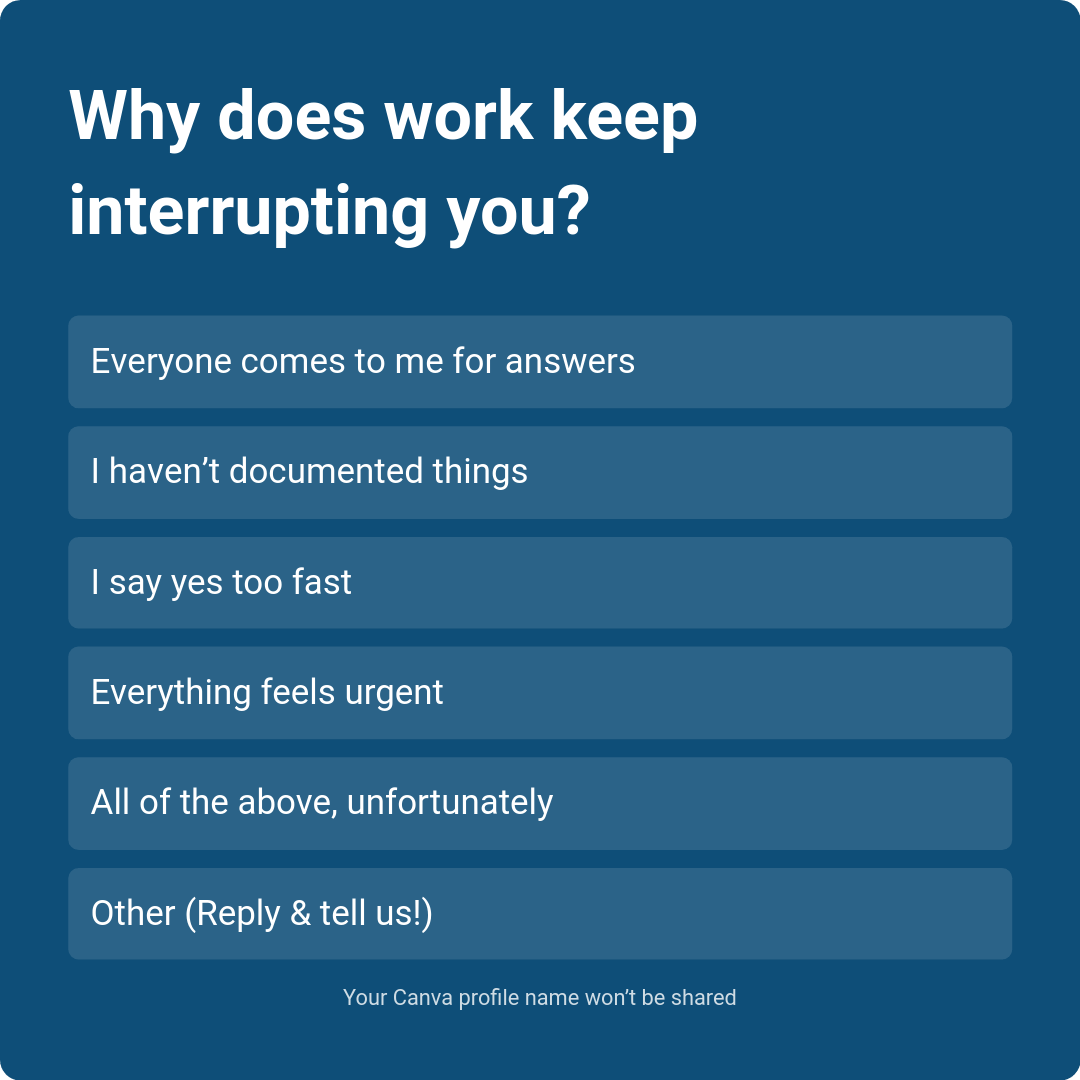
Figure out why this keeps happening
Before you try to fix the interruptions, get honest about what’s causing them.
Are you the only source of truth?
If your team comes to you for every answer, decision, or update, the system only works when you are available.
Are you the default decision-maker?
If progress depends on your sign-off, people learn to wait instead of act.
Is your team unclear on what they own?
When authority is vague, interruptions fill the gap.
Most leaders recognize themselves in at least one of these. Often it’s more than one.
Create systems so people can find answers without you
If you keep answering the same questions, that knowledge needs a home outside your head.
Build resources your team can check before they reach for you.
Start with asynchronous documentation:
When people know where to look, they stop interrupting you by default.
Set clear rules for interruptions
Being accessible does not mean being on call all day.
Decide when interruptions are appropriate and make that visible.
Create office hours.
Choose a daily window for questions and guidance. From 10–11 am, you are available. Outside of that, documentation comes first and non-urgent questions wait.
Protect focus time on your calendar.
Block it and name it clearly. Labels like “Deep Work” or “Heads Down” set expectations. Over time, your team learns that this time is off-limits unless something truly cannot wait. Time blocking works when it is visible and consistent.
Define what “urgent” means.
Urgent work stops everything else. Most things do not qualify.
Boundaries feel awkward at first. Then they become normal.
Stop being the approval choke point
When every decision routes through you, momentum slows across the board.
Ask yourself:
- Which decisions am I holding onto out of habit?
- Which approvals could move forward without me?
- Who is ready to make final calls with context instead of permission?
Leaders who act as bottlenecks often believe they are protecting quality. In reality, they are stalling progress.
Delegation works when it builds judgment, not dependency. Strong teams are trusted to decide.
Start with low-risk approvals. Expand as confidence builds.
Build a team that can move without you
Frequent interruptions usually come from unclear expectations and shaky decision rights.
Coach for judgment.
Walk through how you would think about a decision. Next time, ask them to walk you through theirs.
Acknowledge initiative.
When someone solves a problem without looping you in, reinforce it. Silence often teaches people they overstepped.
Clarify decision rights.
Spell out what people own and when escalation is expected.
Teams that feel trusted move faster.
Treat your time like the finite resource it is
Turn off non-essential notifications. Check Slack and email intentionally instead of reacting in real time. Use Do Not Disturb when you need to think.
Constant availability is not a requirement of seniority.
This does not fix itself
The interruptions will not taper off on their own. You have to design a better system.
That means documentation, clear ownership, and boundaries you actually keep.
If nothing changes, you stay reactive. And the work that requires your experience never gets the space it deserves.
Fix the system. Your calendar will follow.






 Upcoming Events
 Template Drop
 Work Wisdom of the Week: “Don’t be complacent in your career. Growth is everywhere around you.” — Priya Deolall