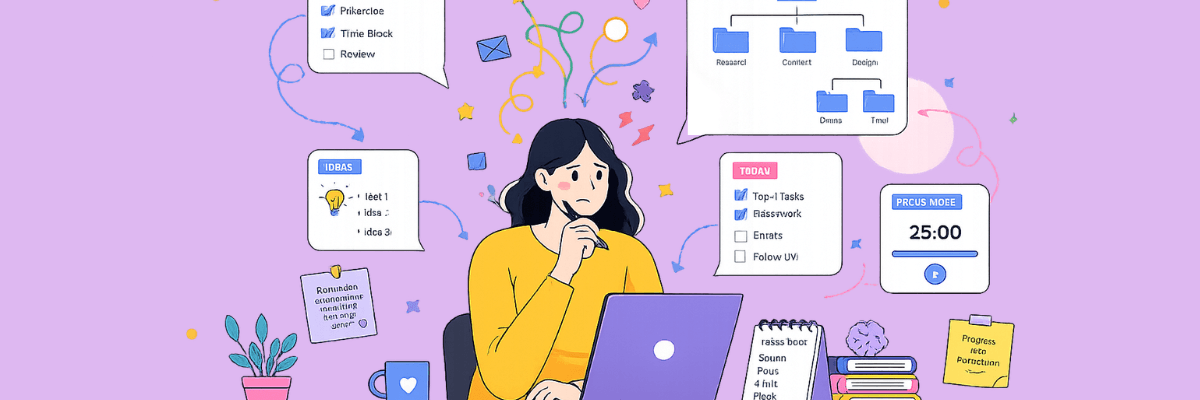
“I have ADHD, and my biggest challenge is remaining consistent with utilizing digital workflow systems that I put in place. I might do really well completing a brain dump and organizing my day every morning for a while, but then I will randomly quit using it for a while, and have to intentionally force myself to pick it back up.” — Rebecca S.
First, let’s normalize this. The start-stop cycle you’re describing is what an ADHD brain does. Systems built for a neurotypical brain feel like a chore the moment the novelty wears off, and that dopamine drop is real.
The goal is to build a system built for your brain. Not what everyone else is doing.
Notice what you default to
When the digital system falls away, what do you reach for instead? A notebook? Sticky notes? Voice memos? Pay attention, because your default is the compass.
If you consistently drift back to analog, your brain is telling you something. Work with it. A hybrid system that starts with a quick handwritten brain dump and then moves to digital is a completely valid workflow. Productivity doesn’t have to live entirely in an app.
Find what your brain naturally reaches for and build around that, instead of forcing yourself back to something that keeps not sticking.
Make consistency the goal
With any new habit, consistency takes time to build, and it rarely looks like a perfect unbroken streak. Missing a day or even a week just means you’re human.
The reframe that helps most: make it easier to get back on. Keep the barrier to re-entry as low as possible. A system that takes two minutes to restart is one you’ll actually return to.
Use AI to do the heavy lifting
AI tools can automate the hardest parts of execution. Use Claude to connect to your Google Calendar and turn a chaotic voice-to-text brain dump into an actual structured day. You talk, it listens, asks clarifying questions about how long each task will take and what the priority is, then places time blocks directly into your calendar.
Voilà. No formatting, no decision fatigue, no staring at a blank planner wondering where to start.
You can also use Claude or ChatGPT as a thought partner to troubleshoot your specific drop-off points. Try: “Help me figure out where in my workflow I lose interest, then design something that excites my brain so I’ll actually keep using it.”
The more specific you are, the more useful it gets.
Make the dopamine work for you
The secret to any system sticking for an ADHD brain is finding the dopamine hit inside it. That might be a satisfying interface, a color-coded calendar, the sound of a task getting checked off, or the visual of a clean schedule taking shape.
Experiment until you land on something that feels good to use. When the system itself is something your brain looks forward to, consistency stops feeling like discipline and starts feeling like a habit.
Your brain just needs a system that was actually designed with it in mind, and you’re allowed to build exactly that. Stop measuring yourself against productivity advice written for someone else’s brain and start getting curious about what works for yours. The right system is out there. You just get to make it.





 Upcoming Events
 Work Wisdom of the Week: