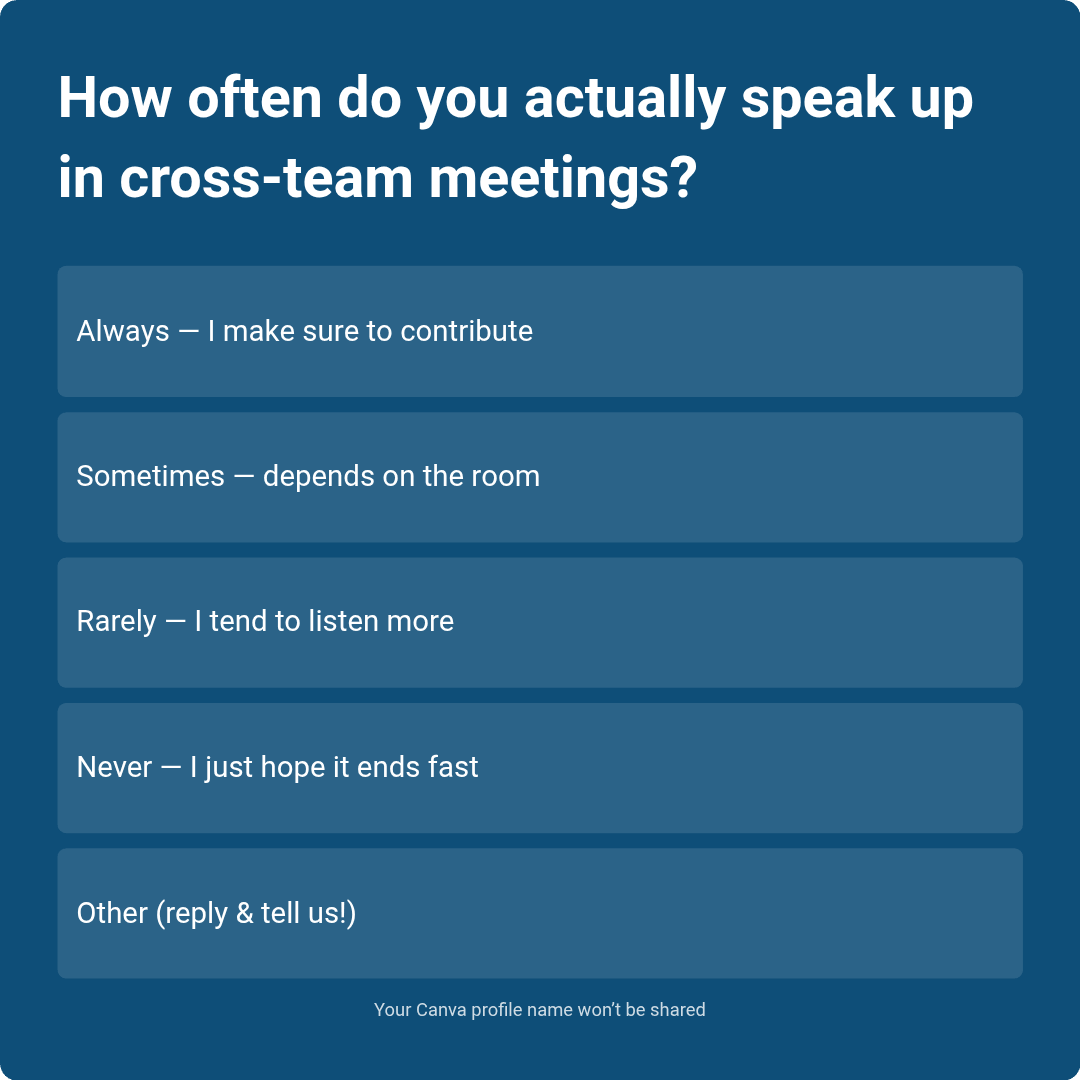
“My biggest problem is speaking up in meetings with people outside my team.” — Brittany A.
If you have ever sat in a cross-functional meeting with a great idea and said absolutely nothing, this is for you. Something about being in a room with people you do not know well has a way of making even the most capable people go quiet.
But here’s what that silence is actually costing you, and more importantly, how to fix it.
Start by figuring out the real root cause
Not all meeting anxiety looks the same, and the fix depends entirely on what is actually driving it. So before anything else, get honest with yourself.
Did something happen with someone on another team that made you pull back? Do you feel like your ideas are not important enough to share? Are you newer to the company and just do not know these people yet? Are you simply more introverted and need more familiarity before you feel comfortable opening up?
The answer matters because a bad experience with a colleague requires a different response than general shyness, which requires a different response than imposter syndrome. Identify the root cause first and then tackle it directly.
Reframe what the meeting actually is
A lot of meeting anxiety comes from treating a meeting like a performance. You are not on stage. Nobody is waiting to judge your delivery or score your contribution on a scale of one to ten.
A meeting is a collaboration. You are there to think out loud with other people, share what you know, and figure things out together. That reframe sounds small but it changes everything. The pressure drops when you stop thinking of yourself as a performer and start thinking of yourself as a contributor.
Remember why you were hired
This one is important. You were hired because someone looked at your skills, your experience, and your perspective and decided the team needed exactly that. When you stay silent in a meeting, you are not just holding yourself back. You are withholding something the room actually needs.
Staying quiet means the people making decisions don’t have your input. That’s a loss for everyone, especially you.
Every meeting is practice for the next one
Every cross-functional meeting is an opportunity to build a skill that will serve you for the rest of your career. Public communication, cross-team influence, executive presence — none of it develops in silence.
Start small. Ask one question. Affirm someone else’s point and add to it. Share one observation. You do not have to deliver a monologue. You just have to show up in the conversation. Each time you do, it gets a little easier and a little more natural.
Build the relationship before the meeting
If unfamiliarity is what is holding you back, close the gap outside the meeting room. A quick intro message, a casual coffee chat, or even a friendly Slack exchange with someone from another team can make the next meeting feel significantly less intimidating.
Familiarity breeds comfort. Comfort breeds confidence.
You already have something worth saying. The room is waiting to hear it.







 Upcoming Events
 Work Wisdom of the Week: