We can all agree that we all hate the way AI writes and that everyone seems to be writing their LinkedIn posts by using ChatGPT, which is fine. Work smarter, not harder, and all that; but if you’re trying to now create content that actually lands with people… it’s not going to if it sounds like everyone else.
Most people are using AI badly. You know exactly what I’m talking about. You scroll past these posts every single day and you can tell within two seconds that ChatGPT wrote them.
The dead giveaways that scream “ChatGPT wrote this”
- “It’s not X, it’s Y.” : This construction is AI’s favorite party trick. “It’s not about working harder, it’s about working smarter.” Cool. Also unnecessarily complicated.
- Repetitive sentence structures: Not this. Not that. Not the other thing. It just sounds like a broken record.
- Random bolding: Words are bolded in the middle of sentences for no reason.
- Emoji overload: 🚀 Every sentence 💡 ends with an emoji 💪 for emphasis ✨ that adds nothing.
- Unnatural paragraph flow: You know, how you, learned paragraph structure in third grade? AI throws that out the window.
Authenticity always wins
As a marketer with 15 years of experience, I can tell you with absolute certainty: the one thing that will always win in communications is authenticity.
That doesn’t mean you can’t use tools, just use them properly. Because like everything else, if you do it lazy, it shows.
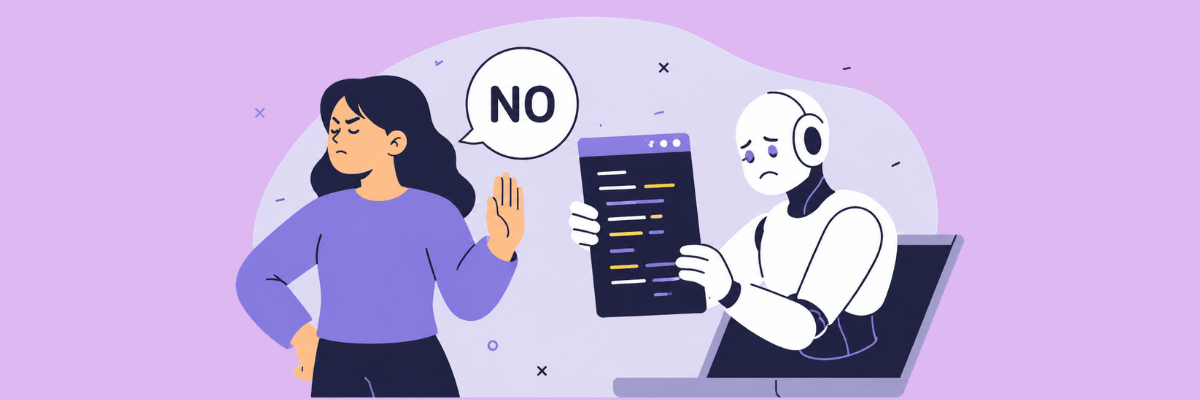
AI is a really powerful tool, but it can’t replace your strategy, your voice, or your perspective. When you let AI do all the work, you strip yourself of creativity and dilute your brand voice. So don’t do it, and lean into your genuine nature.
Five ways to use AI without sounding like a robot
1. Feed it your actual writing first
Before you ever ask AI to write a post for you, give it 5-10 examples of content you wrote yourself, and preferably, with no AI involved. Tell it: “This is my voice. Match this tone, not your default output.”
Also feed it your target audience, and be specific. The more specific you are about who you’re talking to, the less generic the output will be.
2. Write the messy first draft yourself
Don’t open ChatGPT with a blank slate and say “write me a LinkedIn post about productivity.” That’s how you get robotic garbage.
Instead, open a Google Doc and brain dump everything you’re actually thinking. Write it like you’re explaining it to a friend over coffee. Let it be messy.
THEN give that draft to AI and say: “Clean this up, but keep my voice. Don’t make it sound corporate. Keep the energy.”
3. Read it out loud
If you wouldn’t say it out loud to another human being, don’t post it.
Read your AI-generated draft aloud. Does it sound like you talking? Or does it sound like a weirdo TED Talk written by a robotic committee? If it’s the latter, rewrite it.
4. Hunt down the AI tells and delete them
Go through your draft and ctrl+F for these phrases, (unless you literally say this) :
- “In today’s fast-paced world…”
- “Let’s dive in” or “Let’s be honest”
- “Here’s the thing”
- “At the end of the day”
- “Imagine…” followed by a scenario
Delete the filler. When AI uses these phrases, they add nothing. When YOU use them intentionally, they can work. The difference is intention.
5. Let your actual personality show
AI is allergic to imperfection. It wants everything polished, professional, and pleasant.
That’s not what people connect with, though. They connect with real.
Keep the typo if it’s funny. Use the incomplete sentence if it has punch. Tell the story about the time you completely screwed up. Share the unpopular opinion.
Your quirks, your opinions, your stories are what make your content yours. AI can help you structure it and tighten it up, but it can’t give you a personality.
AI is a tool. Don’t let it do the thinking for you. Don’t let it flatten your voice into the same beige corporate-speak everyone else is posting.
Your audience doesn’t need another AI-generated thought leader. They need you. Authentic, messy, opinionated, human you!

Thania (TA Sr. Content Systems)



 Upcoming Events
 Work Wisdom of the Week: