The email from HR lands, or the marketplace notice shows up, and it’s written in a language nobody taught you. Here’s the translation, plus what’s different this year.
The five words that decide what you pay
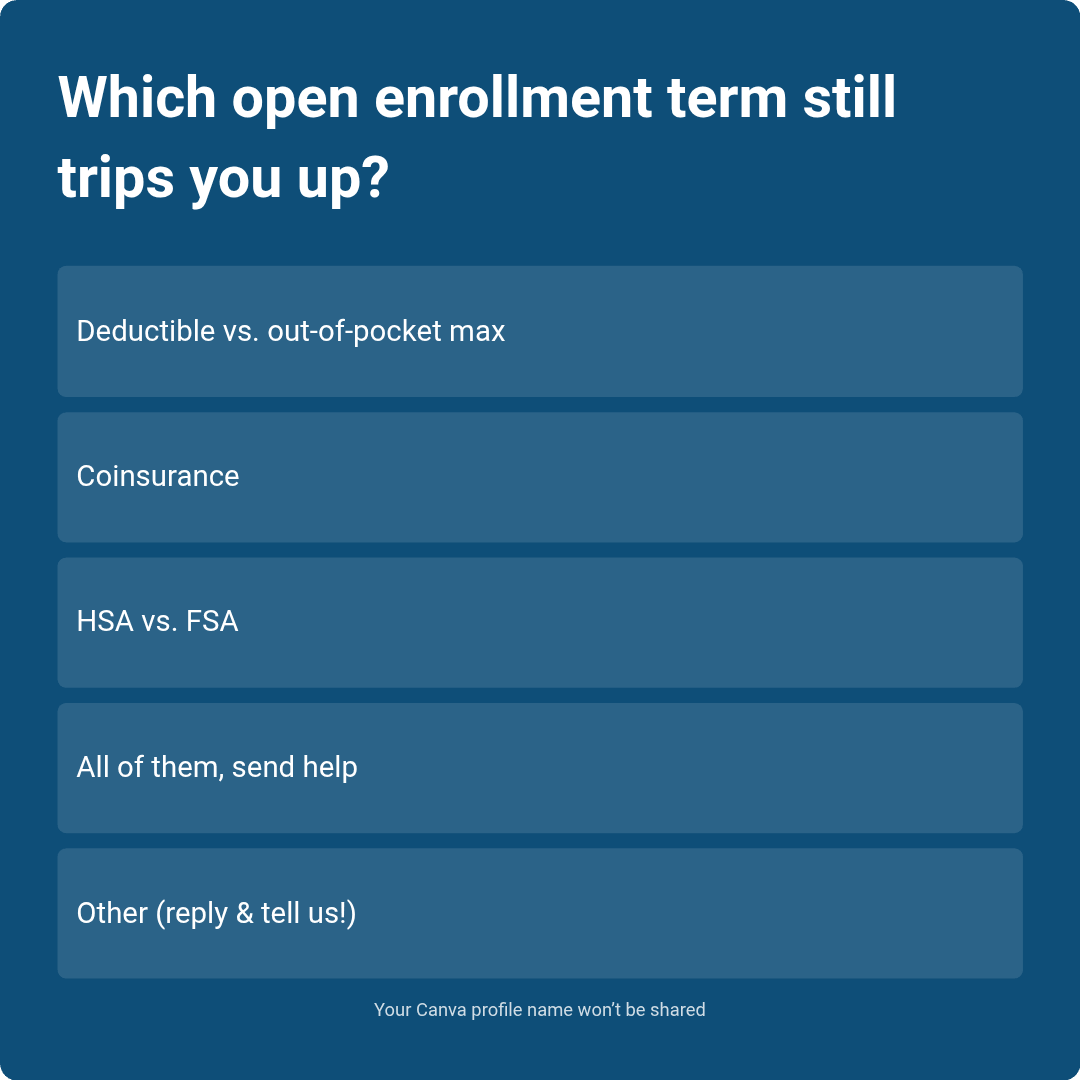
Premium. What you pay monthly whether you see a doctor or not. The number everybody compares, and the one that misleads most.
Deductible. What you pay yourself before the plan starts covering things. Preventive care stays free from day one.
Copay. A flat fee at the point of service. Thirty dollars for a visit, fifteen for a prescription.
Coinsurance. A percentage instead of a flat fee, usually after you’ve hit the deductible.
Out-of-pocket maximum. The ceiling. Once you hit it, the plan covers 100% of in-network care for the rest of the year. The 2027 federal cap is $12,000 for an individual, up from $10,600.
Why the cheapest premium usually isn’t
A low premium almost always comes with a high deductible. That works beautifully if you see a doctor twice a year and takes a serious bite if you don’t.
Take last year’s actual usage, every visit, prescription and scan, and run it against two or three plans. Multiply the premium by twelve, add what you’d owe against each deductible and copay structure, and compare totals. A plan costing $90 more a month can come out thousands ahead if you have anything ongoing.
Then check two things. Are your doctors in network for next year, not just this year? And is every prescription on the formulary, at what tier?
If your coverage comes through work
Most employers run enrollment in October and November, effective January 1. Miss it and you’re locked in until next year unless you have a qualifying life event.
Open the comparison document even if you plan to keep what you have. Deductibles, networks and drug tiers change from year to year, and renewal doesn’t flag any of it.
While you’re there, look at FSA and HSA options. An FSA uses pre-tax dollars and mostly expires at year end. An HSA pairs with a high-deductible plan, rolls over forever, and invests, and the 2027 HSA limits are $4,500 individual and $9,000 family.
If you buy your own
Enrollment opens November 1 and closes January 15 in most states, and December 15 is the deadline for coverage starting January 1. Enroll after that and you’re uninsured through January.
This year deserves extra attention. Premiums are up around 15% at the median, ranging from under 7% in some states to 29% in Arizona. Insurers are pulling out of markets far more often than they’re entering, and hundreds of thousands of marketplace enrollees will see their plans end this year. Subsidies rise alongside benchmark premiums, so anyone without one absorbs the whole increase.
If you’re helping a parent with Medicare
Different system, different calendar, and it closes first. Medicare’s annual enrollment runs October 15 through December 7.
The document that matters arrived in September. The Annual Notice of Change is easy to mistake for junk mail and lists every change coming to their plan. Find it first.
Two things change most often. Part D drug lists reshuffle every year, so a covered medication can move tiers or fall off. Medicare Advantage networks also shift, so a doctor they’ve seen for a decade can drop out of network.
If you buy your own, don’t let it auto-renew
If a plan is ending, auto-renewal hands an algorithm the job of picking your replacement. If it’s continuing, it may be continuing with a different deductible, a different network, or your specialist newly outside it. Nobody is going to call and tell you.
Twenty minutes this fall
Whatever your situation, the move is the same: open the document, read what changed, and decide on purpose instead of by default. It’s less complicated than the to-do list item makes it seem.







 Upcoming Events