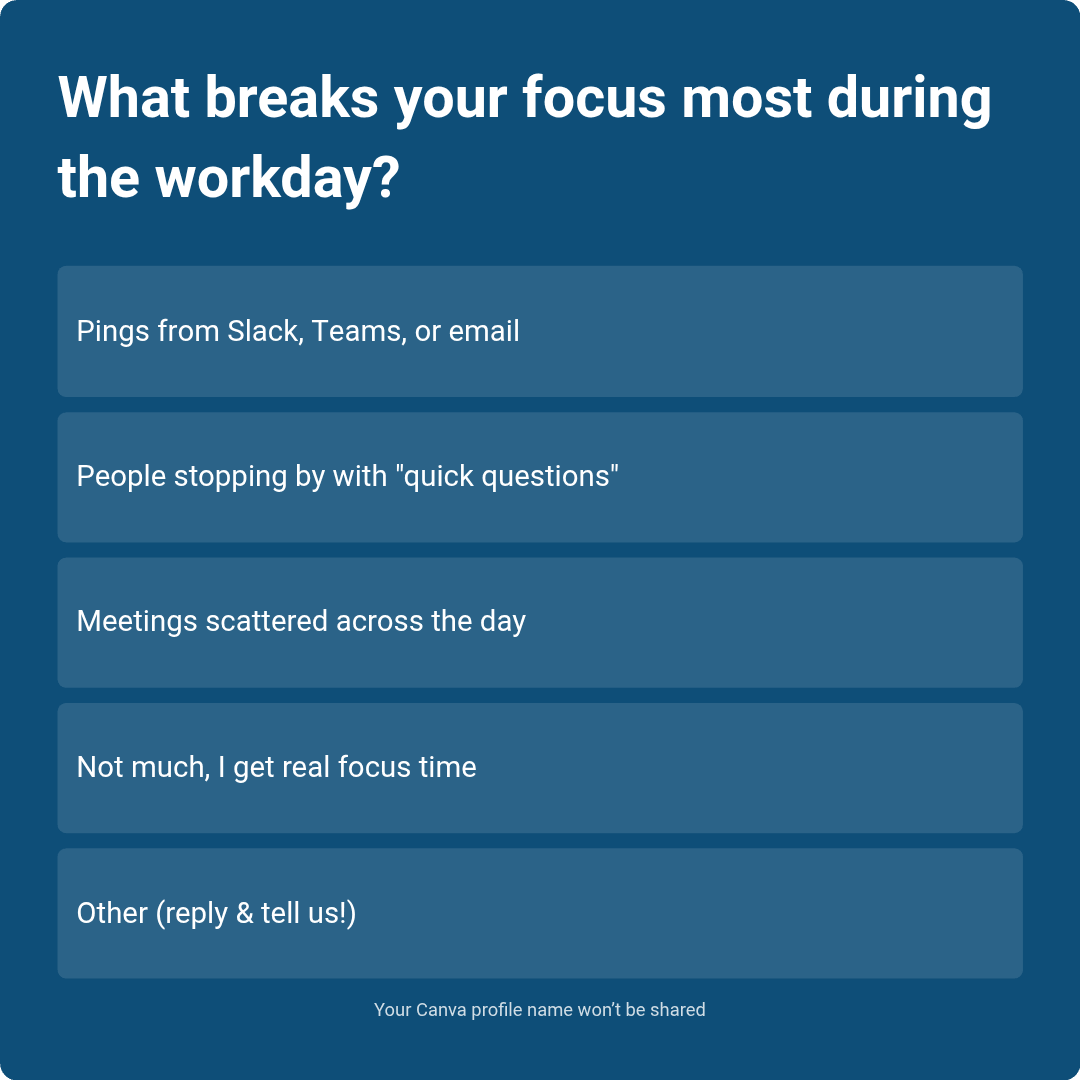
“Biggest challenge is interruptions related to an open-door policy.” (Fiona G., RN)
Fiona, you’re describing a day that mostly belongs to other people’s questions. You’re halfway through a care plan or a staffing email when someone leans in with “got a sec?”, and by the time you get back to it, the thread’s gone. Your open door tells your team they can come to you and that raising a concern will never be held against them, which matters even more in healthcare, where the question someone sits on can turn into a safety issue. Keeping that promise doesn’t mean being reachable every minute of the day.
Keep the promise, change the hours
Pick two or three windows a day, like the start of shift, midday, and late afternoon, when your door is open and your full attention goes to whoever walks in. Tell your team about it as something you’re doing for them: “I want to be fully present when you need me, so here are the best times to catch me.” That lands very differently than “please stop interrupting me.”
Teach the team to triage
Most interruptions fall into one of three buckets, and your team can learn to sort them before they knock:
- Urgent and can’t wait? A patient safety issue, a staffing emergency, a deadline about to be missed. Interrupt immediately, always.
- Time-sensitive but not an emergency? Flag it and give me 15 minutes.
- A question, an update, or a non-urgent request? Save it for office hours or send a message.
Once people know the buckets, they stop defaulting to “go find her” for everything.
Give your door a signal
If there’s no door to close (and on a unit, there usually isn’t), a visual cue does the same job. A small sign, a colored badge clip, or a focus status in Teams can say non-urgent items wait. Expect to reinforce it for the first week or so. After that, it becomes part of how your team works.
Guard one block a day
Interruptions don’t always slow you down, which is part of why they’re easy to shrug off. In one UC Irvine study, people who were interrupted finished their work faster to make up for it, and paid for it with more stress, frustration, and time pressure. Protecting even 30 to 45 minutes of uninterrupted time, ideally before the day speeds up, gives you one stretch where you can think at your own pace. Put it on your calendar and treat it like your most important appointment of the day.
Your open door is how your team knows they can count on you. A little structure around it means you’re still there for them at 4pm, with enough left in the tank to actually listen.






 Upcoming Events
 Work Wisdom of the Week: