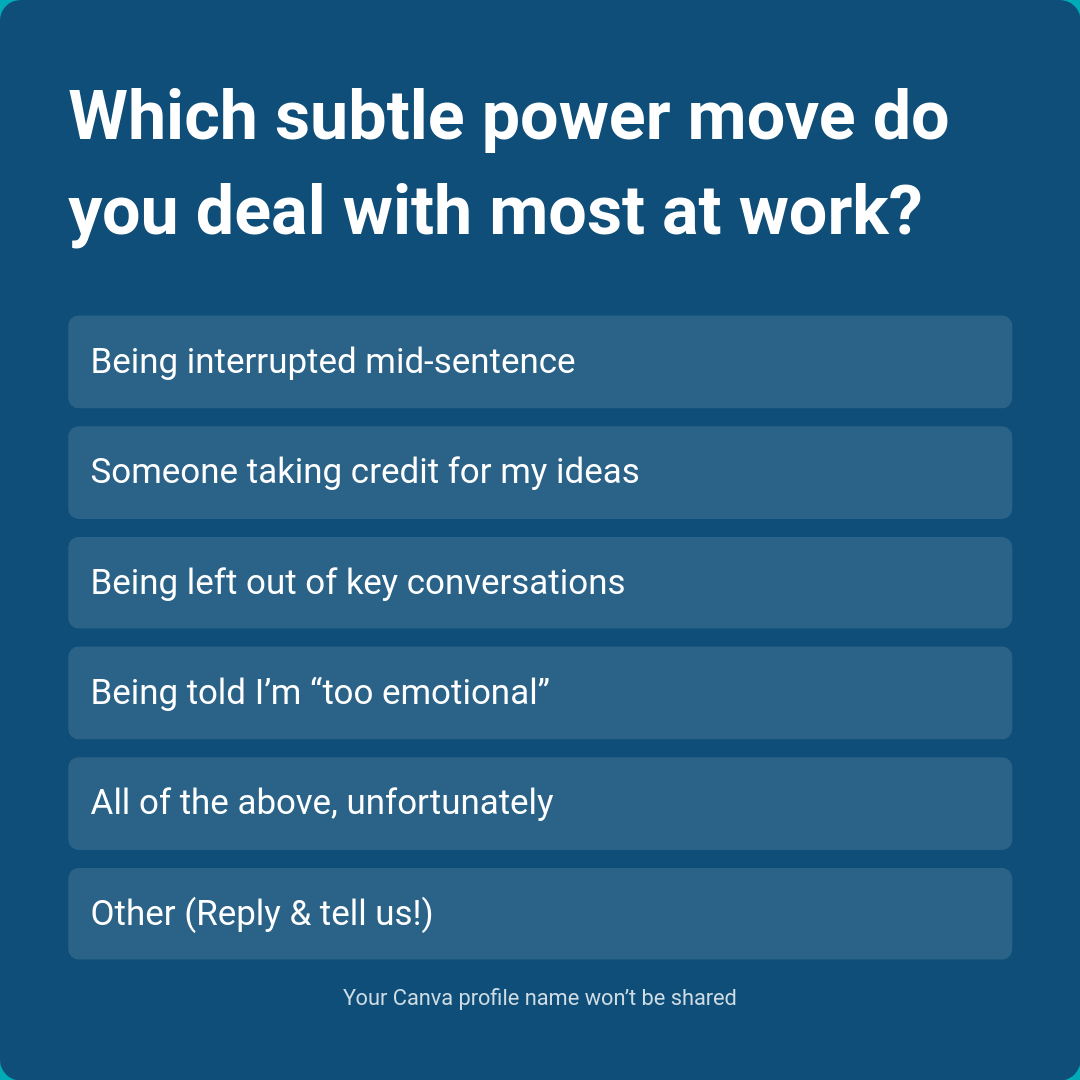
You’re in a meeting. You start to make a point, and a male colleague cuts you off mid-sentence. Later, he repeats your exact idea and gets credit for it. When you push back, you’re told to “relax” or that you’re “being emotional.”
If this feels familiar, it’s because it’s patterned behavior. And it’s rarely accidental.
I was asked to deliver a webinar on “The Art of Being Taken Seriously in a Male-Dominated Field” for an association of women in the metal industry and thought it was valuable to share with you as well.
Truth is, this behavior is a power move. And it’s designed to test what you’ll tolerate, undermine your authority, and keep you off balance.
Here’s how to recognize them and shut them down without losing your composure.
1. The Interrupter (talks over you)
What’s happening: He cuts you off mid-sentence, talks over you, or jumps in before you’ve finished your thought.
What it signals: Your voice doesn’t matter as much as his.
How to handle it: You have options.Pick the one that fits your style:
- Keep talking (steamrolling). Don’t stop. Maintain your volume, pace, and eye contact. Force them to either stop or speak over you continuously. Most interrupters back down when you don’t yield.
- Use firm phrases. Calmly state: “I’m not finished,” “Please let me finish,” or “I’ll appreciate your feedback, but can you hold off until I’m done?”
- The “Thank You” method. Let them finish their interruption, then say “Thank you” and immediately resume exactly where you left off. This acknowledges them without ceding your floor.
2. The Credit Thief (repackages your idea)
What’s happening: You share an idea in a meeting. It gets ignored. Ten minutes later, a male colleague repeats the same idea and everyone loves it.
What it signals: Your contributions aren’t valued unless a man validates them.
How to handle it: In the moment, jump in immediately: “Thanks for building on what I said earlier. To expand on my original point…” Reclaim it publicly and confidently. If you let it slide, it’ll keep happening.
3. The Tester (pushes boundaries to see what you’ll tolerate)
What’s happening: He makes a comment that’s just inappropriate enough to be uncomfortable but subtle enough that calling it out feels like “overreacting.” He’s testing your boundaries.
What it signals: He’s seeing how far he can push before you push back.
How to handle it: Name it immediately. “That’s inappropriate.” “I’m not sure what you meant by that, but it’s not okay.” Don’t laugh it off. Don’t soften it. Set the boundary clearly and firmly.
4. The Minimizer (“you’re cute when you’re mad,” “calm down”)
What’s happening: You express legitimate frustration or disagreement, and he dismisses it by calling you emotional, telling you to relax, or patronizing you.
What it signals: Your feelings aren’t valid. You’re overreacting.
How to handle it: Don’t engage with the emotional framing. Redirect to the substance: “Comments like that make it harder to work together. I’m asking you to address my point.” Or: “Telling me to calm down isn’t a response. Let’s get back to the issue.” Stay calm, stay firm, and refuse to be derailed.
5. The Gatekeeper (withholds info, invites, access)
What’s happening: You’re left off meeting invites, not included in key conversations, or information is withheld from you that everyone else seems to have.
What it signals: You don’t belong in the “inner circle.”
How to handle it: Call it out directly and professionally. “I noticed I wasn’t included in the X meeting. Can you help me understand why?” Or: “I’d like to be included in future conversations about Y since it impacts my work.” Make it awkward for them, not for you.
6. The Bulldog (aggressive tone / intimidation / public challenge)
What’s happening: He uses an aggressive tone, raises his voice, or publicly challenges you in a way that feels like an attack rather than a discussion.
What it signals: Intimidation is a tool to make you back down.
How to handle it: Don’t match his energy. Stay calm. “I’m happy to discuss this, but I need you to lower your voice.” Or: “Let’s table this and revisit when we can have a productive conversation.” If it’s in public, don’t engage. Suggest taking it offline. You’re not required to participate in a performance.
The goal is to control the frame.
These power moves work when you react emotionally, when you shrink, or when you let them slide.
They don’t work when you stay calm, name what’s happening, and refuse to play along.
Keep your cool and remember that you don’t need to “win” the moment. You only need to establish that you won’t tolerate being undermined, dismissed, or disrespected.
So stay grounded in your calm, assertive energy and set the boundary every single time. Yes, it’s difficult but it’s what I think makes women uniquely good at leadership. We’re able to control our emotions, show up with kindness and diplomacy and also draw hard boundaries.
Because once they know you won’t tolerate it, they’ll think twice before repeating the behavior.

Thania (TA Content Mgr)






 Upcoming Events