One of my favorite things I do as a solopreneur is give webinars and talks to women. Last month, I had the privilege of speaking to a women’s association of metalworkers on the topic of building credibility and authority in male-dominated spaces.
And one of the hardest things we struggle with as women? Self-promotion.
In a society where women are conditioned to be nice, modest, and accommodating, we’re not naturally encouraged to showcase our accomplishments and contributions. Meanwhile, men are constantly telling everyone how they contributed, what they did, and how good they were at it without blinking an eye.
Outside of those conditioned gender communication patterns, there’s also a practical issue: we’re so busy doing 100 other things as women (fighting our health insurance for basic reproductive coverage, working the double shift caring for the household, keeping up with 10-step beauty routines and protein intake) that we haven’t spent the time to think about what makes us great in our careers and how to articulate it.
That’s where the credibility backpack comes in.
What is a credibility backpack?
It’s basically a metaphorical tool you can turn to when you need stats, endorsements, and proof, especially in rooms that don’t take you as seriously or where you want to build more authority.
Think of it as a toolbox you can pull from to remind yourself (and others) of your experience, results, competency, and leadership. This translates to more confidence, patience, and wisdom when you need it most.
Why you’re not being taken seriously
First, let’s name what’s actually going on. Because the fix only works if you understand what you’re up against. Here are four reasons women often struggle to be taken seriously.
1. Role confusion
Unclear positioning undermines authority and creates ambiguity about your expertise. If people don’t understand what you do or what you’re good at, they won’t trust you with important work.
2. Soft communication
Over-explaining and excessive apologizing signal uncertainty rather than confidence. When you soften your language (“I just think maybe we could…”), people hear doubt—not expertise.
3. Invisible proof
Your wins aren’t packaged or communicated effectively to build credibility. If you’re doing great work but no one knows about it, it doesn’t help your reputation.
4. The double bind
Navigating the tension between being warm and being direct creates confusion. Women are punished for being “too nice” (not authoritative) and “too direct” (not likeable). It’s exhausting.
What goes in your credibility backpack
Your credibility backpack should include concrete proof of your expertise and impact. Overtime, it’ll come from memory and not something you need to reference. The goal is for you to have examples to easily pull from your brain, but it’s okay if at first you need to access it digitally or physically. Here’s what to collect:
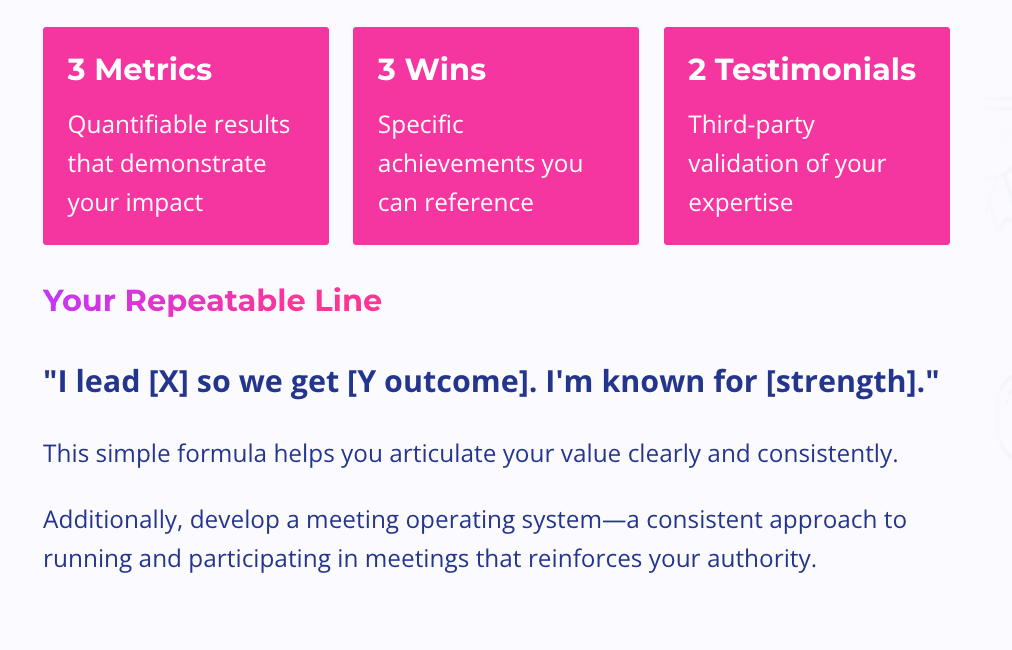
3 Metrics
Quantifiable results that demonstrate your impact:
- “Increased revenue by 22% in Q3”
- “Reduced customer churn by 15%”
- “Managed a $2M budget with zero overruns”
3 Wins
Specific achievements you can reference:
- “Led the product launch that brought in 5,000 new users in 60 days”
- “Negotiated a partnership that saved the company $150K annually”
- “Built and scaled a team from 3 to 15 people”
2 Testimonials
Third-party validation of your expertise:
- A LinkedIn recommendation from a former boss
- An email from a client praising your work
- Feedback from a peer about your leadership
Your repeatable line
You also need a simple, memorable way to articulate your value. Here’s the formula:
“I lead [X] so we get [Y outcome]. I’m known for [strength].”
Examples:
- “I lead product strategy so we launch on time and under budget. I’m known for execution.”
- “I lead sales teams so we consistently hit quota. I’m known for coaching top performers.”
- “I lead operations so nothing falls through the cracks. I’m known for systems thinking.”
How to use your credibility backpack
Keep all these in a document, a folder, or even a physical notebook. The point is to have them ready when you need them, and eventually develop a practice of self-advocacy that’s rooted in data and projects credibility…. and confidence!
Your credibility backpack can be used in:
- Performance reviews and promotion conversations: Pull out your metrics, wins, and testimonials. Make the case with proof, not hope.
- Networking and introductions: When someone asks what you do, lead with your repeatable line and back it up with a win.
- Moments when you’re dismissed or undermined: Calmly redirect with proof. “Actually, I led the project that increased conversions by 18%. Here’s what we learned.”
- Building confidence internally: On hard days, open your backpack. Remind yourself of what you’ve done and what you’re capable of.
Now take 5 minutes to create it
Don’t let this be another article you just read and move on from. Go open up a Google Doc right now and just start typing. List your three metrics. Your three wins. Your two testimonials. Your repeatable line.
Even if it’s messy, even if you have to dig through old emails to find the numbers. Just start. Because that simple act of writing it down? It’s a subconscious signal to yourself that you DO deserve the credibility and authority in every room you walk into. Your backpack exists now. Use it.

Thania (TA Content Mgr)






 Upcoming Events