
I love hosting. I love the moment someone takes a bite, pauses, and goes right back for seconds. I love a full table where people stay long after the pie is gone. I’m also the person who makes everything from scratch, down to the cranberry sauce.
This year, between two kids, a packed work calendar, and a holiday season that started somewhere around Halloween, cooking it all the week of isn’t happening. So I built a Thanksgiving hosting timeline backward from Thursday, November 26, and it’s already saving my sanity.
I shared the short version of my countdown plan in the newsletter. This is the full one: every step, the make-ahead windows I use, the turkey thawing math, an oven schedule you can steal, and the shortcuts I lean on every year. Take what fits your table and skip the rest.
Table of Contents
The short version
- Start about two weeks out. Lock your headcount, dietary needs, and a capped menu (one turkey, four or five sides, two desserts) the weekend of November 14.
- Freeze what holds. Pie dough, herb butter, turkey stock, and a gravy base can all be made early and frozen.
- Thaw a frozen turkey in the fridge for about 24 hours per 4 to 5 pounds, according to the USDA’s Thanksgiving guidance. A 20-pound bird needs four to five days.
- Delegate with specifics. Give every guest an exact answer to “what can I bring?”
- On Thursday, run an oven schedule written backward from dinnertime, and get leftovers into the fridge within two hours.
When should you start preparing for Thanksgiving?
Start about two weeks before Thanksgiving. For 2026, that means making your big decisions the weekend of November 14 and spreading the rest of the work across five stages, so the actual week of Thanksgiving is mostly chopping, assembling, and oven time.
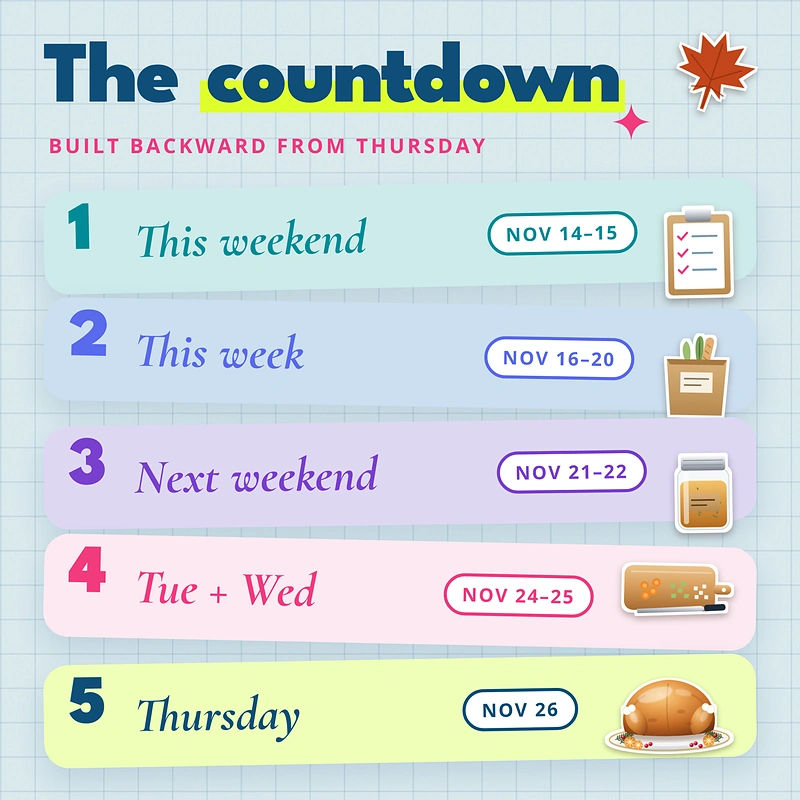
Here’s the Thanksgiving prep timeline I’m running this year:
- This weekend (Nov. 14 and 15): lock the plan. Headcount, allergies, menu, what’s from scratch, and the turkey order.
- This week (Nov. 16 to 20): delegate and stock up. Guest assignments, family jobs, pantry shopping, and the first round of freezer prep.
- Next weekend (Nov. 21 and 22): set the scene and make ahead. Serving dishes, decor, drinks, the turkey thaw, and anything that holds for a few days.
- Tuesday and Wednesday (Nov. 24 and 25): chop, assemble, set. Fresh produce, side prep, casseroles in their dishes, and the table set.
- Thanksgiving morning (Nov. 26): cook and open the door. Oven schedule on the fridge, snack board out, leftover containers ready.
If you’re reading this later than November 14, don’t panic. Compress the first two stages into one evening and keep going. The order matters more than the exact dates.
How do you plan a Thanksgiving menu you can actually pull off?
A doable Thanksgiving menu has a hard cap. Mine is one turkey, four or five sides, and two desserts. Anything beyond that becomes a guest assignment, which is how the menu stays generous without you cooking 11 dishes alone.
1. Get the headcount and dietary needs first
Confirm who’s coming and ask every guest about allergies or dietary needs now, while you can still plan around them. A quick text works: “Making my shopping list this weekend. Any allergies or foods you avoid?” It takes 30 seconds and saves you from finding out at the table that your brother-in-law went vegan in September.
2. Pick a turkey size that fits the table
For a whole bird, Butterball’s rule of thumb is about one pound per person. I round up a few pounds, because leftover turkey sandwiches are half the reason I do this. Twelve people? Look for a 14- to 16-pound turkey.
3. Decide what’s from scratch and what’s a shortcut
This is the decision that makes everything else possible. The turkey, stuffing, and pies are mine, every year. Dinner rolls and ice cream come from a bakery I trust, and nobody has ever complained. Your list will look different, and that’s the point. Pick the two or three dishes you love making and let the rest be good enough.
Shortcuts that don’t taste like shortcuts:
- Bakery dinner rolls, warmed for 10 minutes before serving
- Good vanilla ice cream for the pie
- Pre-cut butternut squash or green beans
- Store-bought puff pastry for an appetizer
- A cheese and cracker board you assemble from the deli case
4. Order the turkey and write down the make-ahead windows
If you want a fresh turkey, order it now and schedule pickup for Tuesday or Wednesday. The USDA recommends buying a fresh turkey only one or two days before you cook it, unless the package has a use-by date that covers the holiday. Then jot each recipe’s make-ahead window next to it on your menu. That list becomes your schedule for the next two weeks.
What can you make ahead for Thanksgiving, and how far ahead?
Most of a from-scratch Thanksgiving can be made ahead. The trick is matching each dish to how long it actually holds: the freezer for things that keep for weeks, the fridge for things that keep for days, and Thursday only for what has to be fresh.

1. Up to two weeks ahead: freeze it
- Pie dough. Make it, wrap it tight, and freeze. Frozen disks take hours to thaw, so move them to the fridge the night before you roll. King Arthur’s pie crumb method is a smart alternative: freeze the flour-and-butter mixture, then add water the day you bake.
- Compound butter. Mash soft butter with herbs, garlic, and lemon zest, roll it into a log, and freeze. It goes under the turkey skin on Thursday.
- Turkey stock. Simmer wings or necks with onion, carrot, and celery, then freeze in quart containers. You’ll use it for gravy and stuffing.
2. Four to five days ahead: chill it or freeze it
- Cranberry sauce. It keeps well in the fridge and tastes better after a few days, so make it the weekend before.
- Gravy base. Make a roux-thickened gravy with your stock, then freeze it. Cooked gravy only keeps one to two days in the fridge, per the Minnesota Department of Health, so the freezer is your friend here. On Thursday, warm it and whisk in the pan drippings.
- A dessert that holds. A fruit pie can be frozen unbaked and baked straight from the freezer, and cookies or a graham cracker crust keep well for days.
3. One to two days ahead: assemble it
- Pumpkin pie. Bake it Tuesday or Wednesday. Pumpkin and other custard pies keep three to four days in the fridge, according to King Arthur Baking.
- Stuffing. Assemble it in its baking dish, cover, and refrigerate. Bake it on Thursday until it reaches 165°F. Bake it in a dish and keep it out of the bird; the USDA advises against stuffing a whole turkey.
- Casseroles. Green bean casserole, sweet potatoes, and mac and cheese can all be assembled and refrigerated so they only need the oven.
- Vegetable prep. Chop onions, celery, and herbs; trim green beans; peel potatoes and keep them covered in cold water in the fridge.
4. Thanksgiving Day: cook it fresh
The turkey, mashed potatoes, final gravy, and anything crispy. That’s it. Everything else just needs heat.
When should you thaw a frozen turkey for Thanksgiving?
Thaw a frozen turkey in the refrigerator, and plan on about 24 hours for every 4 to 5 pounds, per the USDA. For Thanksgiving on November 26, a 20-pound turkey should go into the fridge no later than Saturday, November 21.
Refrigerator thawing times from the Minnesota Department of Health:
- 4 to 12 pounds: 1 to 3 days
- 12 to 16 pounds: 3 to 4 days
- 16 to 20 pounds: 4 to 5 days
- 20 to 24 pounds: 5 to 6 days
Starting a day early is fine. A thawed turkey stays safe in the fridge for another one to two days. Set it on a rimmed sheet pan on the bottom shelf so nothing drips onto the food below.
Running late? Use the cold water method: keep the turkey in its wrapping, submerge it in cold water, change the water every 30 minutes, and plan on about 30 minutes per pound. Cook it right away once it’s thawed.
If something goes sideways, the USDA Meat and Poultry Hotline (1-888-674-6854) is open on Thanksgiving Day from 8 a.m. to 2 p.m. Eastern, and the Butterball Turkey Talk-Line takes calls and texts all season.
What should you ask Thanksgiving guests to bring?
Ask each guest to bring one specific thing: a named side, a bottle of wine, or a bag of ice. A specific answer gets you exactly what you need, and it gives guests a clear way to help, which most of them want.
“Just bring yourself” feels generous in the moment. Then it’s Wednesday night, and you’re the one making every single dish. Try something like: “Could you bring a big green salad for 12? I’ve got the dressing covered.”
Assignments that travel well and stay out of your oven:
- A green salad or a room-temperature vegetable side
- Wine, cider, or sparkling water
- Two bags of ice
- A dessert that doesn’t need reheating
- The bakery rolls, picked up on the way
Give your household real jobs
Delegation starts at home. My husband owns the turkey timeline, start to finish. The kids are in charge of setting the table and making place cards, and they take it seriously. Other jobs that work well for kids and teens: folding napkins, running coat check, filling water glasses, and being the official playlist DJ.
Stock up on everything that keeps
Buy pantry staples, wine, and paper goods this week while the shelves are still full. Think flour, sugar, butter, broth, canned pumpkin, foil, plastic wrap, napkins, and the to-go containers you’ll need for leftovers. Save the fresh produce and dairy for Tuesday.
How do you set a Thanksgiving table without overthinking it?
A simple Thanksgiving table needs a runner, a few candles, and something seasonal from the grocery store. Keep everything low so people can see and talk to each other, and spend your energy on the food.
- Label your serving dishes. Pull out every platter and bowl the weekend before and stick a note on each one saying what goes in it. This saves me more stress than anything else on this list, because it’s how you find out you’re one gravy boat short on Saturday instead of at 3:45 p.m. Thursday.
- Keep decor simple. A runner, a few candles, mini pumpkins, and fresh herbs or greenery from the grocery store. Rosemary and eucalyptus look great and smell like the holidays.
- Go low with centerpieces. If guests have to lean around it to see each other, it’s too tall.
- Set up a drinks station. An ice bucket, wine, sparkling water, a pitcher of something non-alcoholic, glasses, and an opener on a side table. Guests help themselves, and you stay out of bartending.
- Make a playlist. Something low enough to talk over and long enough to outlast dessert.
- Set the table Wednesday night and clear a spot for coats and bags so the entryway doesn’t become a pile.
Before Tuesday, do a light clean so Wednesday is a quick reset.
What does a Thanksgiving Day oven schedule look like?
A Thanksgiving oven schedule is a timeline written backward from dinnertime, so the turkey, sides, and rolls all land hot at once. Write yours on paper and tape it to the fridge Thursday morning, where anyone helping can see it.
Here’s a sample for a 4 p.m. dinner with a 14-pound unstuffed turkey. Adjust for your bird and your oven, and check the USDA roasting chart for your turkey’s size.
- Morning: Take out the compound butter to soften, put out a snack board, and empty the dishwasher.
- 11:00 a.m.: Heat the oven to 325°F. Rub the butter under the skin and get the turkey in by 11:15.
- 1:45 p.m.: Take the stuffing and casseroles out of the fridge to lose their chill. Start checking the turkey’s temperature around 2 p.m.
- 2:15 to 3:00 p.m.: The turkey is done when it reads 165°F in the thickest part of the breast, the innermost thigh, and the innermost wing, per the USDA. Move it to a board, tent with foil, and let it rest at least 20 minutes. A big bird stays hot under foil far longer, which is exactly the window you need.
- 3:00 p.m.: Turn the oven up to 375°F. Stuffing and casseroles go in.
- 3:15 p.m.: Potatoes on the stove. Warm the gravy base and whisk in the pan drippings.
- 3:40 p.m.: Rolls in the oven for 10 minutes. Someone carves.
- 4:00 p.m.: Dinner.
Two things that make Thursday morning easier: a simple snack board so nobody hovers in the kitchen hungry, and leftover containers stacked and ready before anyone sits down. A meat thermometer is the most important tool in the kitchen today. Pop-up timers and “it looks done” both lie.
How do you handle Thanksgiving leftovers safely?
Get leftovers into the fridge within two hours of serving, in shallow containers so they cool quickly. Food left out longer than that becomes unsafe, according to the USDA.
- Turkey and stuffing keep 3 to 4 days in the fridge. Gravy keeps 1 to 2 days (Minnesota Department of Health). The USDA’s easy rule: eat or freeze them by the Monday after Thanksgiving.
- Reheat leftovers to 165°F before eating.
- Freeze what you won’t eat by Monday. Frozen leftovers keep their best quality for two to six months, per the USDA.
- Carve the turkey off the bone before storing it. It cools faster and fits in the fridge.
My favorite part of the night is sending people home with a plate. I keep a stack of deli containers and a marker by the door, and guests pack their own. It’s part of the welcome, and it means I’m not eating stuffing for nine days straight.
Final thoughts
By Thursday morning, the only jobs left are cooking and opening the door. That’s the whole point of building the plan backward. You still get the homemade meal, everyone still goes back for seconds, and you get to spend Thanksgiving at the table with the people you invited. Pick the parts of this plan that fit your house, and let the rest go.
People also ask these questions about hosting Thanksgiving
Q: How far in advance can I prepare Thanksgiving dinner?
A: You can start about two weeks ahead. Pie dough, compound butter, turkey stock, and gravy base freeze well and can be made early. Cranberry sauce can be made four to five days ahead, and casseroles, stuffing, and pumpkin pie can be assembled or baked one to two days before Thanksgiving.
Q: How long does it take to thaw a 20-pound turkey?
A: A 20-pound turkey takes four to five days to thaw in the refrigerator, based on the USDA guideline of about 24 hours per 4 to 5 pounds. For a Thursday Thanksgiving, put it in the fridge by Saturday. In cold water, plan on about 30 minutes per pound and change the water every 30 minutes.
Q: Can I make stuffing the day before Thanksgiving?
A: Yes. Assemble the stuffing in a baking dish, cover it, and refrigerate it overnight, then bake it on Thanksgiving until it reaches 165°F. Bake it separately instead of stuffing it into the turkey, as the USDA recommends.
Q: How much turkey do I need per person?
A: Plan on about one pound of whole turkey per person, which is Butterball’s rule of thumb. Add a few pounds if you want leftovers. For 12 guests, a 14- to 16-pound turkey works well.
Q: How long are Thanksgiving leftovers good for?
A: Cooked turkey and stuffing keep three to four days in the refrigerator, and gravy keeps one to two days. Refrigerate leftovers within two hours of serving, reheat them to 165°F, and freeze anything you won’t eat by the Monday after Thanksgiving.
Q: What should I ask guests to bring to Thanksgiving?
A: Give each guest one specific assignment, like a green salad for 12, two bottles of wine, or two bags of ice. Choose dishes that travel well and don’t need your oven, so Thursday’s cooking schedule stays intact.