
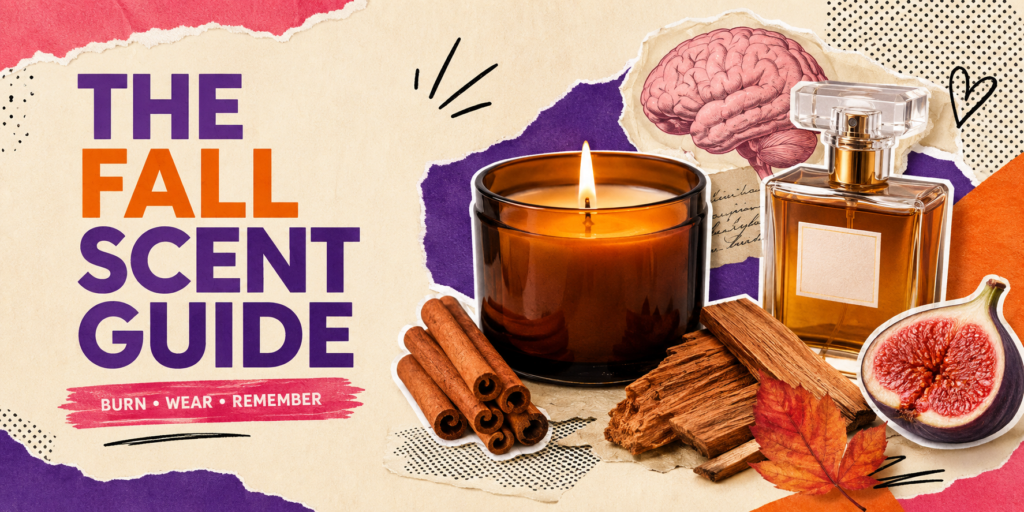
The first cool morning arrives and something in you wants cinnamon. It’s not a decision, it’s a reflex. One day you’re fine with your citrus candle, and the next it feels wrong in the room, like wearing linen in October.
That instinct is worth trusting, and it’s worth understanding. Scent is the only sense wired directly into the part of your brain that stores memory, which is why a whiff of woodsmoke can drop you into a specific October you haven’t thought about in fifteen years.
This fall candle scents guide covers what to burn and wear this fall, why your preferences shift with the season, how to use scent as a memory tool at work, what’s actually inside the candle on your coffee table, and what the TA team is reaching for right now.
Key takeaways
- Heat amplifies fragrance and cold suppresses it. That’s the real reason your scent preferences flip every fall.
- Fall leans woody and spiced: cedar, sandalwood, cinnamon, clove, fig, tobacco. Deeper resinous notes are consistently associated with comfort and grounding.
- Smell is the only sense that skips the thalamus and connects directly to the amygdala and hippocampus, the brain’s emotion and memory centers.
- Scent works as a memory bookmark: learn something with a distinctive smell present, then bring that smell back when you need to recall it.
- Burning candles releases fine particles and VOCs. Risk is low with normal use and ventilation, higher in small closed rooms.
- To judge a candle in a store, smell the lid, not the wax. The wax is muted; the lid holds the concentrated scent.
Table of Contents
What scents should you wear and burn in the fall?

Fall fragrance runs woody, spiced, and a little smoky, and this is where most people’s preferences shift hardest all year.
Reach for: cedarwood, sandalwood, vetiver, patchouli, cinnamon, clove, nutmeg, cardamom, apple, fig, tobacco, leather, and amber.
For your home: anything in the woody or spiced range. Fig and cedar read as sophisticated fall. Cinnamon and clove read as cozy fall. Tobacco and leather read as moody fall. Pick your register and commit to it.
For your skin: this is the season a fuller concentration finally earns its keep. An eau de parfum that felt like too much in July sits exactly right in October, because cold air suppresses projection. If your summer signature suddenly feels thin on you, blame the weather, not the bottle.
Why the pull is so strong. Warm skin and warm air make scent molecules evaporate faster, so heavy notes overwhelm in summer heat and land perfectly once the temperature drops. Layer on that deeper resinous notes are consistently associated with comfort and grounding, and the September craving for something warm makes complete sense.
What are the fragrance families?
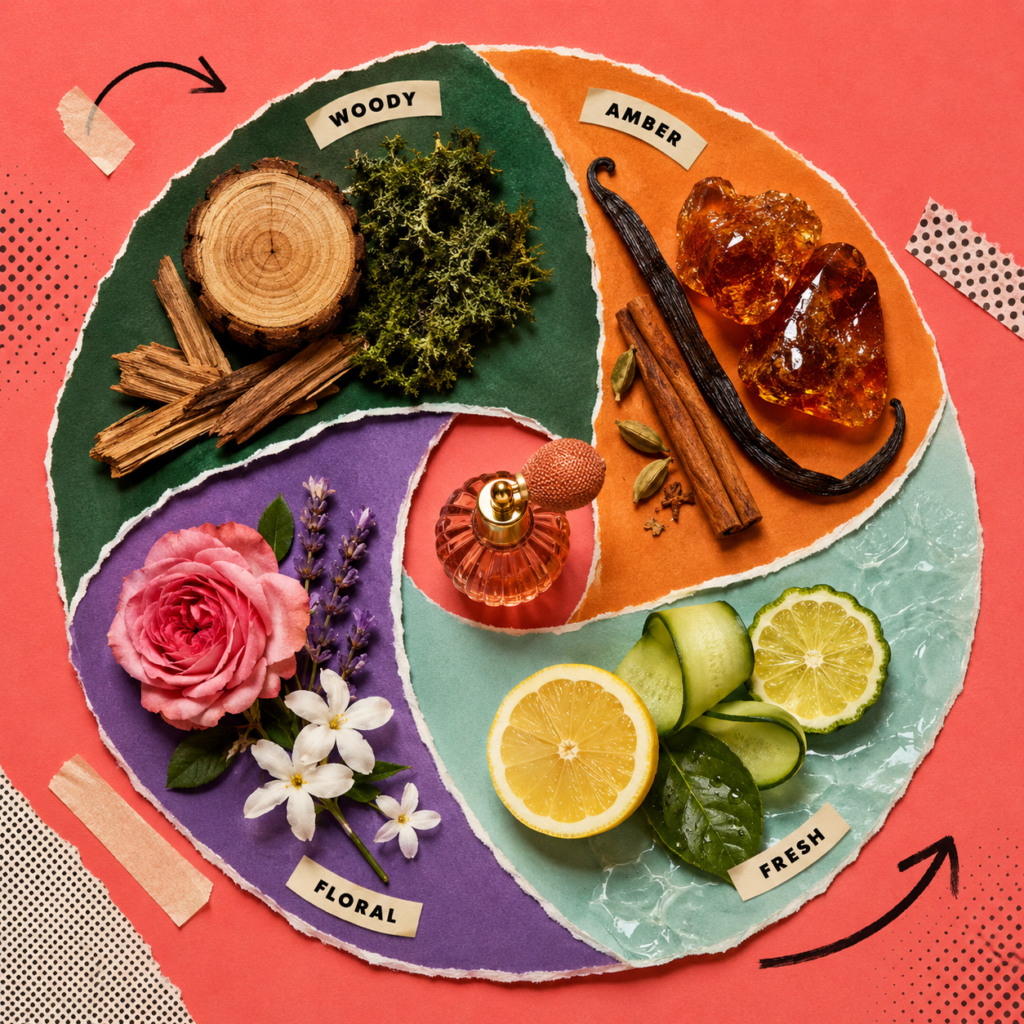
Fragrance is organized into four families, and knowing which one you gravitate toward makes shopping dramatically faster.
The system comes from the Fragrance Wheel, created by perfumer Michael Edwards in 1983. It sorts every scent into one of four families, and two of them are exactly what fall is pulling you toward.
🌲 Woody. Rich and grounded, with a sense of warmth and comfort. Smells like dry wood, campfire, earth, or moss. Common notes: cedarwood, sandalwood, patchouli, vetiver. The primary fall family.
🍦 Amber. Formerly called “oriental.” Warm and luxurious, sweet ingredients layered with spice. Smells like exotic spice, rich resin, and dessert. Common notes: vanilla, cinnamon, cardamom, amber. The other fall family, and the one that carries you straight into winter.
🌸 Floral. The most common and popular group year-round. Smells like fresh-cut flowers or soft powder: sweet, romantic, blossomy. Common notes: rose, jasmine, lily, lavender. Best for spring and daytime.
🍋 Fresh. Clean, bright, energetic. Smells like zesty citrus, snapped green leaves, or salt air. Common notes: lemon, bergamot, cucumber, marine notes. Best for summer and your gym bag.
What scents fit spring, summer, and winter?

Spring: floral and fresh. Light, green, and a little dewy. Reach for cherry blossom, peony, lily of the valley, freesia, green tea, cut grass, bergamot, and neroli. At home, clean laundry and linen scents work.
Summer: fresh and fruity. Heat intensifies projection, so go lighter in both note and concentration. Reach for lemon, grapefruit, cucumber, mint, coconut, marine and salt notes, and juicy fruit like mango, peach, and passionfruit.
Winter: amber, gourmand, and resin. The heaviest, richest scents you own. Reach for vanilla, amber, tonka bean, benzoin, myrrh, frankincense, praline, chocolate, and coffee. Peppermint, pine, and balsam fir carry the holiday version.
A note on rules: none of this is binding. If you want vanilla in July or citrus in January, that’s a preference, not a mistake. Use the seasonal framework when you’re shopping and unsure, and ignore it the moment you already know what you love.
Why do scents trigger memories and emotions?

Smell is the only sense with a direct line to the brain’s memory and emotion centers, which is why odors trigger memories more vividly than sights or sounds do.
Every other sense routes through the thalamus first, a kind of switchboard that filters and forwards signals. Smell signals bypass the thalamus entirely and go straight to the olfactory bulb, then to the amygdala (emotional processing) and the hippocampus (memory formation). Northwestern researchers compared connectivity between each primary sensory area and the hippocampus and found olfaction had the strongest link of any sense. Their own description: a superhighway from smell to memory.
Research also shows odor-evoked memories carry more emotion than memories triggered by images or words, and that positive scent memories can lower stress markers and lift mood.
Even Disney is in on this game. In 1986 the company patented a device called the Smellitizer, an air cannon that pushes scent up to 200 feet toward guests, timed by computer. On Main Street, the vents under the shop windows carry vanilla and baked goods. Pirates of the Caribbean gets salty sea air. Spaceship Earth gets burning lumber.
The original Epcot engineering notes are the interesting part: some scents were designed to be barely perceptible. The aroma would be there, but you wouldn’t consciously register it. You’d just feel a certain way about the place and not know why. That’s the whole mechanism, packaged and sold.
Your house works the same way. Whatever you burn this fall becomes the smell your kids associate with October twenty years from now.
Can a scent actually make you more focused?

Partly, yes, and the mechanism is more interesting than the marketing.
The scent-as-bookmark trick. This is the finding with the most practical use. Researchers call it olfactory context-dependent memory: information learned in the presence of a specific smell is recalled better when that same smell is present again. A 2022 study found congruent odor at both encoding and recall meaningfully improved free recall of a text a week later.
Two rules make it work. The scent has to be present both when you’re learning and when you’re retrieving it. And it works best when the scent is distinctive, meaning something you don’t smell all day. In one experiment, an unusual floral note (osmanthus) outperformed everything else, and peppermint beat “clean fresh pine” purely because pine was too ordinary for the room to register as a cue.
How to use it: pick a candle or oil you don’t otherwise burn. Light it while you’re prepping for the board presentation, learning the new system, or writing the thing you’ll need to speak to later. Bring it back the day you need to recall it. You’ve built yourself a retrieval cue.
The stimulant scents. Peppermint has the strongest track record. In a study of 144 volunteers, peppermint aroma enhanced memory performance and increased self-reported alertness, while ylang-ylang did the opposite, impairing memory and slowing processing speed. Rosemary is the other repeat performer: its active compound, 1,8-cineole, shows up in the bloodstream after inhalation, and higher blood concentrations correlate with better cognitive scores in a dose-dependent way. If a candle isn’t your thing, you can work the same trick into your routine with a peppermint shampoo bar.
The honest caveat, because this field gets oversold: results are inconsistent. A 2025 review found peppermint and rosemary produced no significant effect on memory performance in its sample, and outcomes varied substantially depending on whether participants actually liked the scent. Effects, where they exist, are modest and cluster around verbal recall and alertness rather than general intelligence. Nobody is testing better because of a candle.
What this is worth in practice: the context cue is real and free to try. The alertness bump from peppermint or rosemary is worth a shot on an afternoon when you’re fading. Neither one replaces sleep, and if you hate how peppermint smells, the research suggests it won’t help you anyway.
Are scented candles bad for you?

Burning any candle releases fine particulate matter and volatile organic compounds into your air, and how much that matters depends on the wax, the fragrance, the room size, and the ventilation. Fall is exactly when the windows close and the candle habit ramps up, so it’s worth knowing before the season starts.
What the research shows. Paraffin is a petroleum byproduct, and burning it can release VOCs including benzene and toluene. Stanford researchers found trace amounts of those compounds above burning wicks and concluded that with normal use in a ventilated space, the risk is low. Synthetic fragrance is the second variable: many contain phthalates, which are hormone disruptors, and dyes add another layer.
Where it gets real. In under-ventilated rooms, peak fine-particle concentrations from scented candles can spike to many times WHO guideline limits and stay elevated after the flame is out. This is the fall problem specifically: closed windows plus more burning adds up to a very different exposure than the same candle in July with the door open.
The counterpoint. The National Candle Association maintains candles are safe for home use, citing a 2021 study that burned 24 soy and paraffin candles. An earlier internationally funded emissions study found total VOC levels in a closed room averaged under 2% of the applicable indoor air-quality standard across wax types, with no benzene detected.
The honest read: if you burn a candle a few evenings a week in a normal-sized room with air moving, you are almost certainly fine. If you have asthma, small kids, birds, or you’re pregnant, tighten up the wax and fragrance choices and crack a window even when it’s cold. If you see black soot rings on your jar or your walls, that’s your air quality telling on itself.
What should you look for in a candle?

Think of this as a spectrum, not a pass/fail test. Every step toward the cleaner end helps, and none of it requires throwing out what’s already on your shelf.
The cleaner end of the spectrum:
- Soy, coconut, or beeswax. All burn cooler and produce less soot than paraffin. Pure beeswax produces the fewest particles of the common waxes. Try this delicious Pumpkin Spice candle.
- Cotton or wood wicks. Both are standard now.
- “Phthalate-free” stated on the label. Fragrance formulas are legally protected as trade secrets, so a brand that volunteers this is telling you something.
- A published ingredient list. Real transparency looks like an actual list, not the word “clean” on a label.
- Undyed or lightly colored wax. Dyes add combustion byproducts and do nothing for the scent.
Worth limiting:
- Paraffin blends, especially scented and dyed together
- Anything with no ingredient information anywhere on the site
- Heavily dyed novelty candles
- Burning in a small closed room like a bathroom
And regardless of what you buy: trim the wick to a quarter inch before every burn, keep the lid on between uses, burn in a room with airflow, and put it out if you see smoke or soot. Those habits do more for your air than switching brands does. We like this candle care kit.
How bad is it if your candles are paraffin? It’s not a crisis. Occasional use in a ventilated room stays low-level. Use what you have, ventilate while you burn, and upgrade as you replace.
Candles or diffusers: which one should you use?
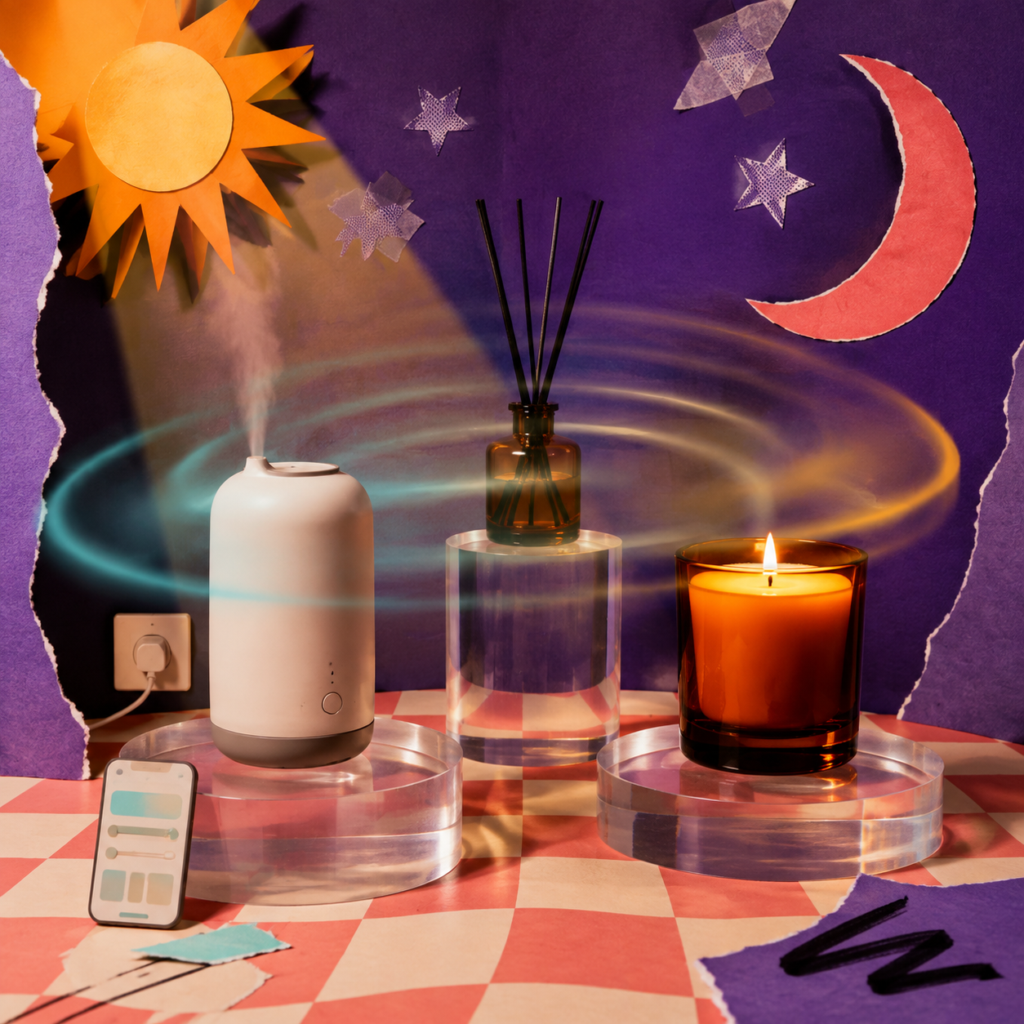
Candles win on ambiance and scent throw, which is most of the appeal in fall. They also require combustion, which is the entire source of the particulate issue. Best for: larger rooms, evenings, occasions, when the flame is part of the point.
Diffusers skip combustion entirely, so no soot, no fire risk, and no forgetting to blow something out. Smart diffusers like Pura run on schedules through an app, hold two fragrances at once, and scent up to about 1,000 square feet. The Pura Smart Diffuser itself comes in three sizes, Home Mini for a bedroom or office, Home for a standard living room, and Home Plus for a larger or open-concept space, and every version lets you set schedules, adjust intensity, and choose from more than 300 fragrances, all from your phone. Best for: small spaces, apartments, homes with kids or asthma, and anyone who wants scent running while they’re not in the room. Pair one with a fall-appropriate refill like Vanilla Sky, a fluffy vanilla blend built on sparkling pear and white bergamot up top, peony and cyclamen in the middle, and cloud musk and creamy woods at the base. It’s IFRA-compliant and formulated to be kid- and pet-safe, and one vial runs up to 30 days.
Reed diffusers are the passive middle option: no heat, no electricity, low intensity, good for a powder room or entryway.
The realistic answer for most people is both. A diffuser as the everyday baseline, a candle when you want the moment.
Is home fragrance safe around kids and pets?

Home fragrance safety depends entirely on which pet is in the house, so the answer isn’t one-size-fits-all.
Birds: no diffusers, full stop. The ASPCA recommends avoiding essential oil diffusers entirely in homes with birds because their respiratory tracts are exceptionally sensitive.
Cats: be careful. Cats can’t metabolize the phenols in many essential oils, and the ASPCA identifies essential oils as one of the most common toxic causes of tremors in cats. Passive diffuser exposure usually shows up as respiratory irritation, but oil settling on fur that a cat then grooms off is a genuine ingestion risk.
Dogs: more tolerant than cats, still more sensitive than you. The ASPCA’s position is that short-term use in a secured, well-ventilated area your pet can’t access is not likely to be an issue, and that pets with any breathing history should skip it.
Watch for: sneezing, wheezing, watery eyes, drooling, lethargy, or pawing at the mouth. If you see those, ventilate the room and call your vet. ASPCA Animal Poison Control: (888) 426-4435.
Kid- and pet-friendly picks: Pura formulates paraben- and phthalate-free, publishes a “no list” of excluded ingredients, and states its fragrances are kid- and pet-safe. Drift is the low-lift car option. Whatever brand you choose, use it in a ventilated room, keep it out of paws’ reach, and watch how your animals respond the first few times.
How do you shop for a candle you’ll actually like?
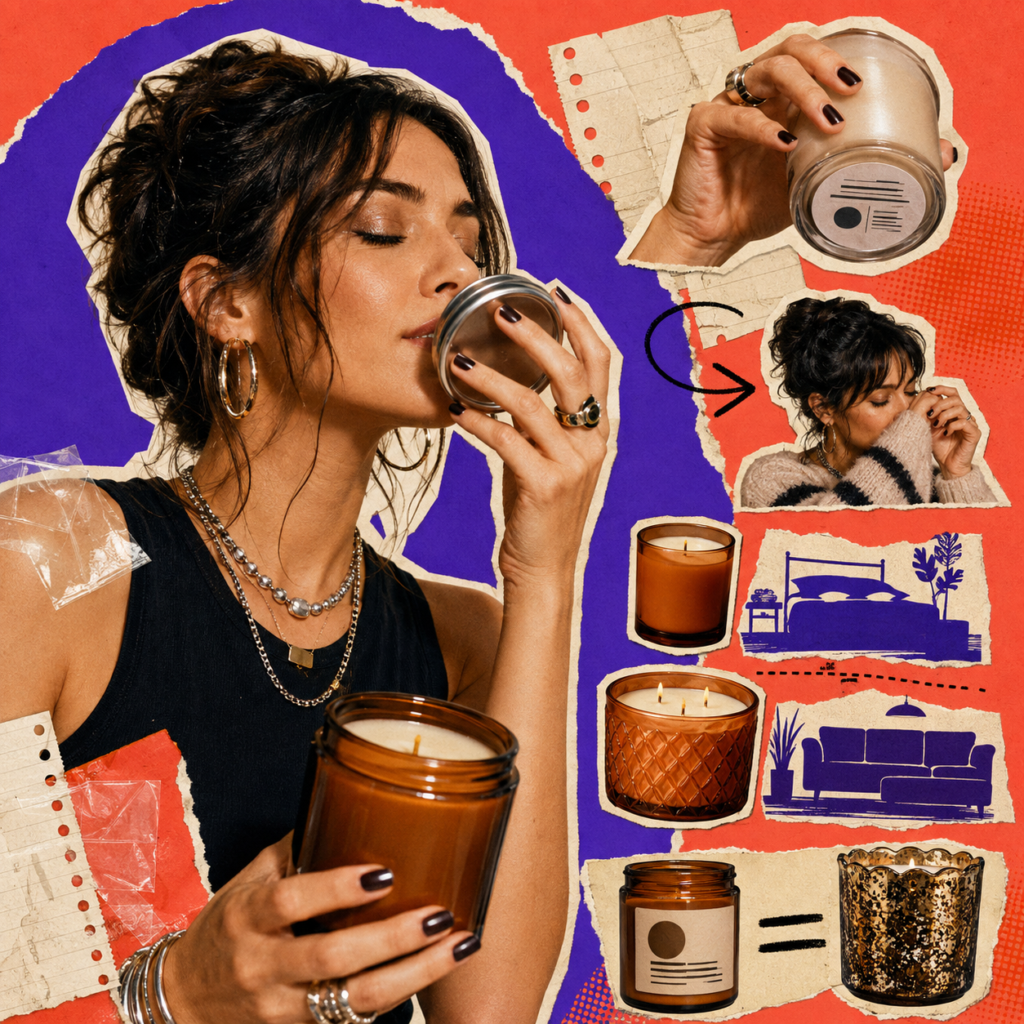
Smell the lid, not the wax. This is the single best in-store tip. Cold wax gives you a muted, incomplete version of the scent. The lid has been sitting on top of that fragrance for weeks and holds the concentrated version, much closer to what you’ll get when it’s lit.
Reset your nose. After three or four candles, your olfactory receptors are saturated and everything smells the same. Smell your own sleeve, step away for a minute, then continue.
Check the wax and wick before the label design. Wax type is usually printed on the bottom of the jar.
Know that price and quality aren’t the same thing. A $9.99 grocery store candle and a $58 boutique candle can use identical fragrance oils. What you’re often paying for is the vessel and the branding. Where price does track quality: wax type, fragrance load, and wick engineering.
Match the candle to the room size. One wick for a bedroom or office. Three wicks for an open living room.
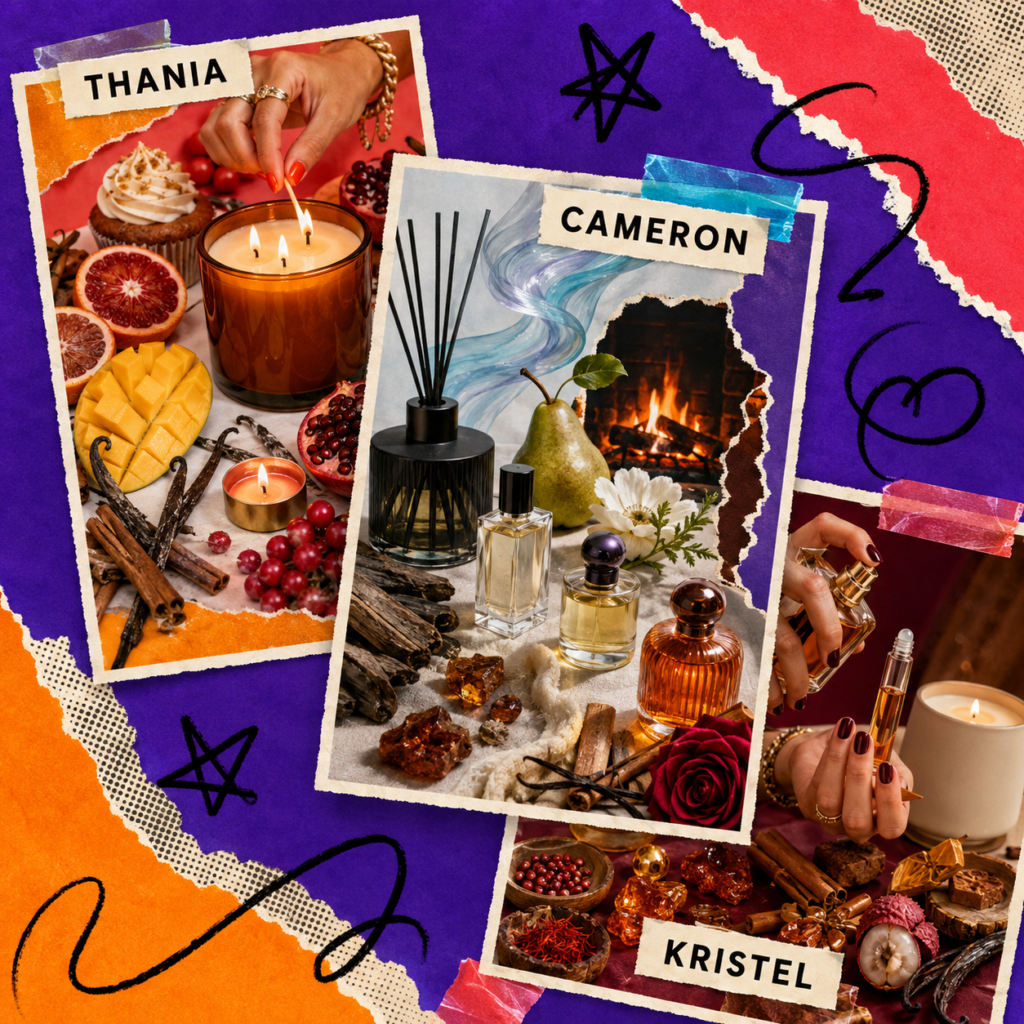
What is the TA team burning right now?
Thania
My favorite scents are vanillas, cinnamons, cupcakes, and fruity smells like mango and tropicals. I’m not much for florals or earthy smells.
When it comes to candles, I won’t lie: I’m the girl buying candles from Ralph’s for $9.99. And yes, I just read an entire section above about wax types, and yes, my picks are paraffin blends. I’m working on it! Here’s what I actually reach for:
Target. This vanilla and bergamot one crushes in smell and the wooden wick is fancy. I love blood orange and pomegranate too.
IKEA. Always a go-to for me. Tea lights in vanilla, green apple, and red berries.
Cameron
Around the house: Volcano by Capri Blue, on repeat in my Pura smart diffuser. Fresh and clean, and it’s the scent that makes my house feel like mine.
Perfume, since we’re heading into fall: I’m drawn to woody and amber this time of year.
- Commodity Milk. My everyday fall scent. Warm and comforting, but soothing and personable.
- Jo Malone Scarlett Poppy. Jo Malone is nostalgic for me as a brand; my signature was English Pear and Freesia for years. Scarlett Poppy is fun, girly, flirty. Perfect for brunch or a girls’ night.
- YSL Black Opium Date night, every time. It’s become so tied to date nights with my fiancé that I cherish it.
- Noyz Only Human. Another everyday go-to. Simple, but woven into so many regular days that it just feels like me.
- REPLICA By the Fireplace. My cozy night-in scent, hands down.
- PHLUR Father Figure. My in-between scent, warm enough for summer with the first hint of fall in it.
Kristel
I love cinnamon, vanilla, amber, and sandalwood. Anything warm, rich, and a little luxurious. Fresh and fruity has never been my lane; give me feminine and cozy instead.
For non-toxic candles I’m loyal to Farm + Sea’s Classic Candle in Santal: sandalwood, musk, and a touch of spice, clean-burning with no phthalates, and it still smells expensive.
Perfume:
- Gucci Guilty. Warm, a little smoky, confident without trying too hard. Amber and patchouli with enough pink pepper to keep it from feeling heavy.
- Delina by Parfums de Marly. Rose and lychee up top settling into vanilla and sandalwood. Still there hours later without a reapplication.
- Baccarat Rouge 540. Amber, saffron, and cedar. The one people can identify blind.
- Scandal by Givenchy. Honeyed gardenia with a patchouli edge, with enough praline warmth to sit next to the rest of my rotation.
My one non-negotiable: I always layer a vanilla musk oil underneath whatever I’m wearing. It adds warmth and makes everything last so much longer.
Fall scents are yours to make
Scent is the cheapest, fastest way to change how a room feels, and one of the only ones that installs itself into memory without asking permission. That’s worth being a little intentional about before the season fully turns.
Pick your fall note, smell the lid before you buy, crack a window while you burn, and let it become the thing you remember about this October.
People also ask about fall candles and scents
Q: What scents are best for fall?
A: Woody and amber notes dominate fall fragrance: cedarwood, sandalwood, vetiver, patchouli, cinnamon, clove, fig, tobacco, and leather. Cold air suppresses fragrance projection, so richer, fuller concentrations work better than they would in summer.
Q: Why do my scent preferences change in the fall?
A: Heat amplifies fragrance and cold suppresses it, so heavy notes that overwhelm in summer land correctly once temperatures drop. Deeper resinous notes are also consistently associated with comfort and grounding, which is why they feel right as the weather turns.
Q: Can smelling something help you remember better?
A: Yes, through olfactory context-dependent memory. Information learned while a distinctive scent is present is recalled more accurately when that same scent is present again. The effect requires the scent at both learning and recall, and works best with a smell you don’t encounter regularly.
Q: Why do smells bring back memories so strongly?
A: Smell is the only sense that bypasses the thalamus and connects directly to the amygdala and hippocampus, the brain regions that handle emotion and memory. Northwestern research found olfaction has stronger connectivity to the hippocampus than any other sense.
Q: Are soy candles actually better than paraffin?
A: Soy, coconut, and beeswax burn cooler and produce less soot than paraffin, which is a petroleum byproduct. All candles emit some fine particles when burned, and the bigger variable is often the fragrance and dye.
Q: Why should you smell a candle’s lid instead of the wax?
A: Cold wax releases only a muted version of the fragrance. The lid traps concentrated scent from sitting on top of the candle, so it’s a much closer preview of how the candle will smell when lit.
Q: Can I use a diffuser if I have a cat?
A: With caution. Cats can’t metabolize the phenols in many essential oils. Use a diffuser only in a well-ventilated room your cat can’t access, run it for short periods, and stop if you see drooling, wheezing, or watery eyes. Avoid it entirely if you have birds.
Q: What’s the difference between a candle and a smart diffuser?
A: A candle burns wax and wick, which gives stronger ambiance but releases soot and VOCs. A smart diffuser like Pura uses no flame, so it skips the particulate issue entirely, runs on a schedule through an app, and can hold two fragrances at once.
Want more of this in your inbox? Wellness Wednesday brings you research-backed wellness, product picks the team actually uses, and the occasional deep dive like this one. Sign up here.
Last updated: August 2026
This article is informational and not medical or veterinary advice. If you have asthma, respiratory conditions, are pregnant, or have concerns about a pet’s exposure, talk to a licensed provider or your vet.