
✅ Today’s Checklist:
- How to stay connected when you feel lonely at work
- Four scripts for the performance talk you keep postponing
- Why the hard thing is worth saying out loud
🤔 Riddle me this: What English word keeps the same pronunciation even after you remove four of its five letters? (Find the answer on the bottom).
📅 Wed 9/2 @ 11am PT: Setbacks happen. This live Resilience Workshop with NextArrow gives you the tools to bounce back faster.
QUICK LINKS
🛍️ 13 Labor Day sales actually worth bookmarking this year.
🎾 Xero’s CEO on what a tennis legend taught her about leadership.
💰 High earners with stale plans are leaving tax savings behind.
🛡️ Five skills that will AI-proof your career (according to LinkedIn data).
WORK LONELINESS

How To Build the Work Friendships That Used To Just Happen
It’s 2pm on a Wednesday. You’ve been at your kitchen table since eight, you’ve said maybe forty words out loud all day, and three of them were to your dog. The flexibility is great and you wouldn’t trade it back. But somewhere in there, work got very quiet.
Gallup found that one in five employees worldwide feel lonely on a given day, and fully remote workers report it at 25% compared to 16% for people working entirely on-site. Remote work removed the accidental fixes: the hallway chat, the shared lunch, the walk to the parking garage.
The office isn’t a cure either. You can sit on an open floor with thirty coworkers and still feel completely unseen.
Connection at work stopped happening by accident. Now you have to go build it.
If you’re working remotely
Get in a room with people who do what you do. Search Eventbrite or Meetup for your city and your field, and go to one thing this month. You don’t have to work the room, just be in it.
Try a coworking space part-time. Most offer day passes, so two mornings a week costs less than a monthly membership and gets you back into ambient conversation with other working adults.
Find an online community that’s actually active. Our Smart Girl Society is built for this, with live sessions when you want real-time connection and async threads when you need to ask a question at 11pm and hear back from women who’ve been there.
Make your remote team fun on purpose. Start a Slack or Teams channel for something ridiculous. Propose a monthly virtual coffee with no agenda. Culture on a remote team is something you build deliberately or don’t get at all.
If you’re lonely in an office full of people
Find the overlap. You need people who share an interest with you. Start a book club, a lunchtime walking crew, a parents-of-toddlers channel. One shared thing turns a coworker into a person.
Look outside your company too. Networking groups give you peers who get your work without the internal politics.
When nothing out there fits, build it
If none of the existing groups are for you, pitch one. A lunch-and-learn series. A monthly cross-department mixer. A volunteer day.
You don’t need a title to do any of this, and being the person who makes the thing happen puts you on the radar of people two levels up. The connection is the point. The visibility is a very good side effect.
You get to decide how this feels
Nobody is going to schedule your belonging for you. Pick one thing, do it this week, and see how next Wednesday afternoon feels.
AI RISK CHECK
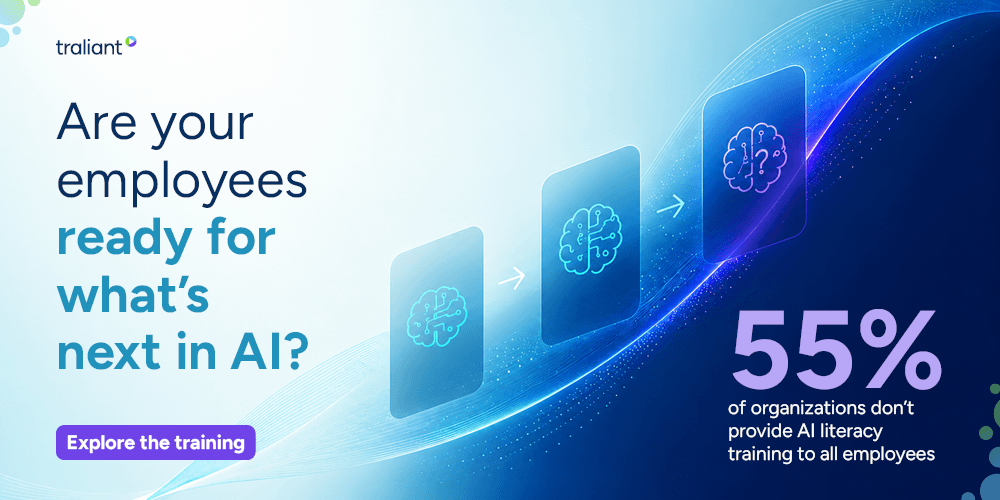
Your Team is Already Using AI. Nobody Told Them the Rules.
Someone on your team pasted a client contract into ChatGPT last week, and you’ll find out how it went in about six months.
Most companies are past the question of whether employees use AI. Only 45% train all of them on how to use it responsibly, and the rules keep moving: the EU AI Act, Colorado, Texas, and whatever lands next quarter.
Traliant’s AI in the Workplace training is a 15-minute, attorney-authored course that teaches employees the five questions to ask before they open a GenAI tool, how to keep sensitive data out of it, and how to check output for bias and accuracy. Then 40 two-minute Micro Reels and a 15-minute refresher keep it current as the tools and the laws change.
BIGGEST CHALLENGE

How to Have The Performance Conversation You’ve Been Putting Off
“I’m having difficult conversations with employees who are not putting in the hours to get their job done.” — Carrie C.
The conversation you keep rehearsing in your head is almost always harder in your head than it is in the room. The longer you wait, the more weight it accumulates. So let’s get you in the room.
Open with the observation, not the judgment
The biggest mistake managers make going into a performance conversation is leading with their conclusion instead of their evidence. The moment someone feels accused, they get defensive, and the conversation stops being productive.
Start with what you have observed, specifically and neutrally:
“I want to talk about something I’ve been noticing. Over the last few weeks, I’ve seen [specific pattern — deliverables coming in late, availability during core hours, output dropping]. I want to understand what’s going on from your side before we figure out next steps together.”
That’s it. One observation, one invitation. That opens a door, which is the entire job of the first three minutes.
Separate the performance gap from the person
Before you assume disengagement, remind yourself that you don’t yet know the cause. Underperformance shows up for a lot of reasons — a personal crisis, unclear expectations, a skills gap, burnout, or yes, sometimes a motivation problem. The conversation will go very differently depending on which one it is.
Your job in the first conversation is to find out. Ask directly:
“Is there something going on that’s making it hard to show up at full capacity right now? I’d rather know so we can figure out what support looks like.”
Some people will tell you immediately. Others won’t. Either way, you’ve signaled that you’re a manager who leads with curiosity before consequences, which makes the next conversation easier if you need to have one.
Be clear about what needs to change and by when
Empathy without clarity isn’t kindness. After you’ve listened, name the expectation plainly:
“Here’s what I need to see: [specific behavior or output], by [specific date or timeframe]. That’s what success looks like in this role right now.”
No softening or burying it in qualifiers. Clear is kind, and vague is what breeds resentment on both sides three months from now.
Close with a check-in date, not a warning
Put the next check-in on the calendar before either of you leaves the room. A specific date turns this into an accountability structure you both agreed to, and it tells them you are invested in seeing them get there.
“Let’s check back in on [specific date] and see where things stand. I’m rooting for you to get there.”
If you’re not a manager, this still applies
Sharing a project with a peer whose piece keeps slipping? Same framework. Swap “as your manager” for “as someone who shares this deadline with you,” and the conversation stays on the work itself. Lead with the observation, ask what’s going on, name what you need, set a check-in.
The conversation is uncomfortable for about ten minutes. The alternative is uncomfortable for months.
BUSINESS SAVINGS

The Free Account That Untangles Business Spend From Your Prime Cart
Your printer paper, the team’s snacks, and a birthday gift for your sister are all sitting in the same order history. Come January, someone has to separate them, and that someone is you.
Amazon Business is a separate, free account for the work side of that cart. Same selection and same delivery you already use, plus business-only pricing and quantity discounts on office supplies, breakroom stock, tech, and industrial gear.
Approval workflows let you see what your team is spending before the invoice shows up, and Business Prime (the paid tier) adds free one and two-day shipping.
New customers get 20% off a first order, up to $100, just for creating the free account. No subscription, no commitment.
STAFF PICKS
Stuff We’re Loving This Week
👉 This Month: Scott Galloway and AI leaders share how to make your AI spend defensible. Free on 9/17.
🗒 For the pen-and-paper gals who still need to digitize: the reMarkable tablet.
🎧 Budget earbuds usually mean bad sound, but these wireless earbuds punch way above their price.
🧺 Give pantry chaos a glow up with these stackable organizers that make everything easier to spot.
JUST FOR FUN
COMMUNITY
 Upcoming Events
- Wed 9/2 @ 11am PT: Resilience Workshop with NextArrow
- Tue 9/8 @ 12PM PT: Coworking Session (SGS Only* | Join the waitlist)
- Tue 9/15 @ 11AM PT: Build Your Own AI Assistant: Live Co-Learning Session (SGS Only* | Join the waitlist)
- Thu 9/17 @ 10AM PT: Beyond the Brand with Laura Weldy (SGS Only* | Join the waitlist)
- Fri 9/18 @ 9AM PT: Part 2 of a 2-Part Investing Series with Tess Waresmith (SGS Only* | Join the waitlist)
* Smart Girl Society is our private community for women who want deeper conversations, accountability, and tools that actually make life easier. Join the waitlist to get in the next round.
 Work Wisdom of the Week:
“Don’t be afraid to speak up and say the hard thing. You aren’t the only one thinking it.”

Jacki R, Director


SPILL THE TEA
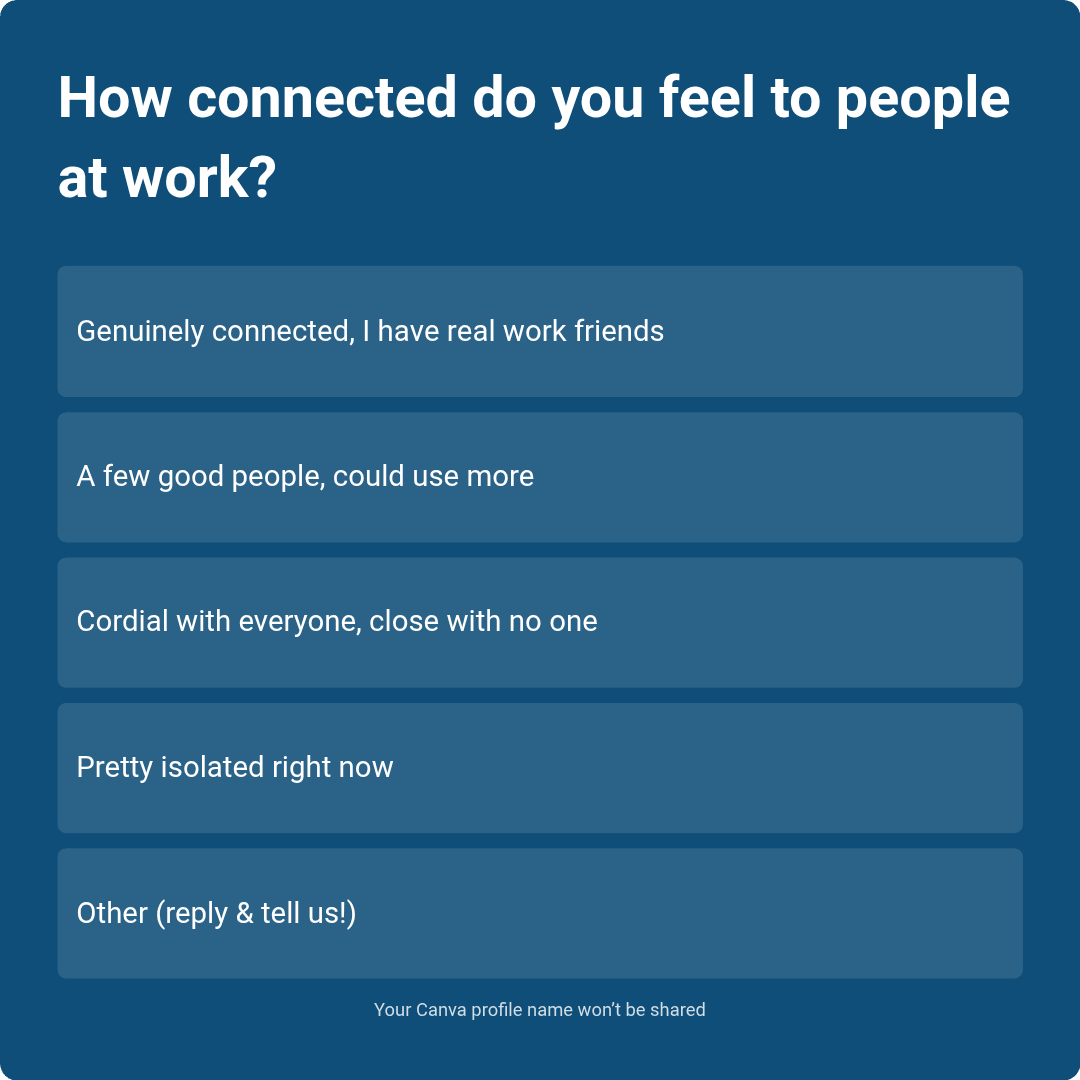
Take Our Poll
Have more feedback? 💌 Reply to this email and tell us.
✨ P.S. Want more inspiration and positivity to kick off your week? Sign up for our Motivational Monday texts (U.S. only).
👀 Want to see if your company is a good fit for our 250k+ ambitious readers? Join our Sponsor Waitlist here.